The Ever Growing List of Things I’ve Given Up in the Name of Frugality

My ultimate goal is to pay down my student debt of $550k as fast as possible. I turned to frugality as a way to do that. I’ve given up some excesses in my day to day life in order to reach my goal quicker. I find that it’s not a shame to be more selective, but rather a source of pride. Plus one if the decision ends up being eco-friendly. And the list goes on…

  • Gym memberships, specifically yoga-related. Substitute yoga at home, swimming laps at the community pool, and biking everywhere.
  • Weekly Sunday brunches. Learned how to make equally as good breakfast dishes at home.
  • The thought of a new car. Still driving my high-school ride.
  • Happy Hour Thursdays. Weekly football viewing now occurs at home.
  • Regularly dining out at trendy, fancy restaurants. Once a month Ramen date, still a likely occurrence.
  • Shopping, in general.
  • Cable TV at home. Thought about nixing the internet too, only for a moment.
  • Buying books. Exchanged my habit for public libraries instead.
  • Alcohol. Initially, paying money for it was a main factor. Additionally, positive health outcomes.
  • Outsourcing house-cleaning and maintenance jobs. Learned how to fix a continually running toilet, efflorescent cement floors, and clogged drains to name a few. Also a fan of touch up painting as a “hobby”.
  • Paying $15 to watch movies at the theatres.
  • Drinking anything but water at restaurants.
  • Buying music.
  • Paper Towels. Substitute washable dish rags instead. Also eco-friendly.
  • The idea of buying things new. Became a big fan of buying things used. Even bigger fan of hand-me-downs and borrowing.
  • Driving everywhere. Biking to local errands becoming more common.
  • Paying for parking spots. Will walk reasonably extensive distances to avoid paying for parking.
  • Personal space, specifically, an entire floor in our loft. Got a roommate in order to decrease monthly rent, a not-so-traditional way to reduce spending, in order to live in the house of our dreams.
  • Buying bottled water. Opting for filter water not only saves the environment but also saves money. I carry a water bottle around everywhere and fill up at public water fountains.
  • Buying lattes every week. I learned how to make them myself at home, latte art included! Also applies to $8 avocado toast.
  • Buying bread. I bake my own bread, and feed my own yeast. Also, started selling my extra loaves to people as well.
  • House decorations. I really embraced the minimalist esthetics, and it’s a plus for me because there are less things to clean and organize, and the space always looks neat.
  • Frequent haircuts. I cut my hair once every 2 years, which people say is sooo unhealthy, but is it really when my hair continues to grow faster than most people I know? I don’t have split ends and I still consider my hair pretty thick. Then again, I don’t shower in hot water and I don’t blow dry, curl, or dye my hair, barring twice a year exceptions.
  • Make-up and beauty products. I no longer wear make-up on my days off, and I only wear a dash of eyeliner and mascara on the days I go to work. I wash my face with regular soap, and avoid moisturizers and other unnecessary (and at times, harmful?) products. I used to have a habit of painting my nails every week, but I am haven’t painted them in over a year. They’re healthier than before, always trimmed, and match every outfit.
  • Snacks. When I was still in college, I realized that I was being unhealthy by reaching into the pantry for chips or the freezer for ice cream. I challenged myself to stop buying snacks to prevent myself from eating bad foods, but also to cut my grocery bill. It’s worked and I stick to the habit of cutting out snacks from the grocery list to this day.
  • Going to theme parks and concerts and festivals. This kind of goes in line with the movie theatres thing, but I substituted all of these hyped and commercialized experiences for explorations and hikes with friends.
  • Speaking of friends, I gave up the relationships that were centered around spending. I realized that we unfortunately had different visions as to how we want our lives to be, and it comes down to our core values being different. For those that were willing to hang out with us without the instagrammable scenery, we remained friends. Some of these things were harder to give up than others.
  • Going to Target, “just because”. This is the worst, am I right? (See also: Trader Joe’s.) I will have a mission and a list when I go into stores and groceries, and I stay focused on my goals.
  • Fast food. We originally stopped getting fast food because we didn’t want things that involved plastic and single use containers. However, getting rid of fast food is also amazing since it reduced our spending. It is so easy to think, “Oh, it’s just cheap fast food, so no big deal.” But the pennies do add up. And it is important to remember that fast food is not entirely healthy, so the cost of treating things such as high cholesterol and diabetes down the road will be increased if eating fast food is a common occurrence. Don’t get me started on our college days…
  • Buying pre-made meals and sauces. Cooking most things from scratch was initially started to reduce plastic, but it also prevented me from buying things that are wayyyy too overpriced for what you are getting.

More to come…

Travel: Rothenberg Ob Der Tauber, Germany

I am usually not a city girl. When I think of the ideal places to travel to and explore, I never come up with a city. Mike, however, loves exploring cities. We try to find a happy medium between the two of us, alternating destinations so that we discover something about each other’s interests while achieving interests of our own.

When we decided to go to Germany, it wasn’t because we had been dying to go for a long time or anything like that. Mike follows a website called Scott’s Cheap Flights and he has signed up to receive notifications for when flights go on sale. Usually, the deals are incredibly discounted, but you need to have flexibility as to where you want to go and when. For example, if there is a specific place you want to go to, you have to cross your fingers that a deal comes up sometime. It makes it even more difficult when you also have a specific timeline. For cases where you already know what you want to see and when, I would recommend other modes of finding cheap flights, such as the Hopper app. But it was through Scott’s Cheap Flights that we heard about a round-trip fare to Munich, Germany for roughly $500 per person. Additionally, the dates of Octoberfest were included in the dates available to get said discounted rates. Mike had wanted to check out Octoberfest in Germany with friends, so we mass e-mailed (or maybe we texted?) our core group of ten friends this amazing deal. We had only two takers, another married couple in our group of friends, so it is with this reasoning that we chose Germany as a fall trip. Unfortunately, something came up and the two friends couldn’t make it, which left us flying to Germany solo, but which also gave us more freedom as to what we wanted to see.

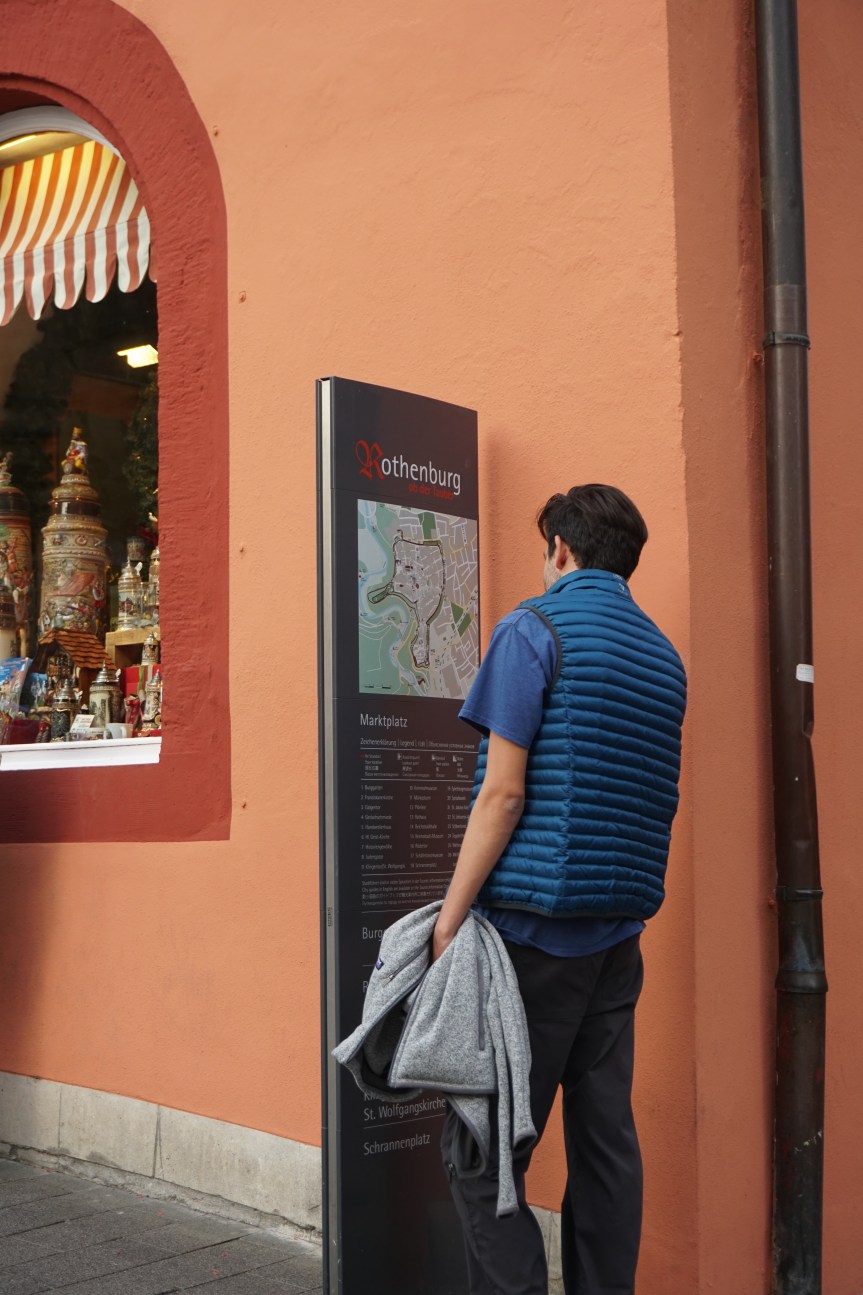
When we booked Germany, I thought that I would not enjoy this trip at all. Mike was rather stoked on the prospect of visiting a bunch of different cities and this was our first time to Europe, but I hated visiting New York, disliked living in LA, and Queenstown in New Zealand was my least favorite part of our trip there – not because these cities were awful but I just don’t like the general vibe of large cities. I need the room to hear myself think, the smell of freshly cut grass or dewy trees, the sound of rushing water. So off course, since I had control over the planning of the trip, I actually tried moving us away from Munich and spending as little time as possible in Frankfurt. What ended up happening was that every night for five nights in a row, we slept in a different city. And I ended up falling in love with Germany. One city in particular took my breath away, with its sleepy cobblestone streets, its strong standing walls, and the lovely character and charm of its fairytale buildings.

Rothenberg ob der tauber used to be a very prosperous town. In between two main cities, many traders used to stop at this city in between their travels to get a night’s rest and something to eat. Guarded by a wall surrounding the entire city, they were well protected because they could choose who they allowed in and out. The nightwatchmen roamed the streets in the evenings, making sure no one but the inhabitants and their welcomed guests were within the city.

Unfortunately, during the Thirty Year’s War, protestant troops of 40,000 men wanted to rest at Rothernburg because the winter weather was making it difficult for them to progress from one city to the other. Rothernburg refused to comply with their request, and a siege occurred. Rothernburg was captured by the troops, and after the winter, the town was left poor and quite desolate. A few years later, the bubonic plague came to the city, killing many of the townsfolk. Without money or power, the city could not grow, and thus preserving its 17th century state. I learned all of this through the amusing Night Watchman’s Tour , a definite must for anyone who visits.

DSC00169

We started off our exploration by entering the city gates and climbing one of the towers. We walked along the top of the city walls, peering into the city to get a preview, as well as looking out the manholes to see the outside. Walls that have stood since 950 BC or earlier, these monsters of stones held in the city’s traditional appearance, while the rest of the world lost its charm and moved on. From these walls, you can view the city in its entirety over the rooftops of residential houses.

DSC00032DSC00036DSC00044DSC00055DSC00064DSC00067

After meandering around the perimeter, we decided to go ahead and officially enter the city and roam the streets.

When we first walked the streets of Rothernburg, I felt like I was in such a dream state. I couldn’t believe that such a place not only existed, but functioned as a real city rather than a preserved museum. One of the largest houses on the street has been occupied by the same family for 300 years! As a girl who moved ten times before reaching high school, it was an unthinkable concept. The beauty of the place was just outstanding. I knew I had to see it for myself without any distractions.

DSC00095DSC00105DSC00106DSC00120DSC00128DSC00135DSC00138DSC00142DSC00160

So the next morning, I woke up very early to explore on my own. I took my camera with me, and walked the foggy streets, with nary a visitor in sight. Sleepily, the town woke, as if from a spell. The scenes I captured were just so unreal. There was one in particular that I was on a mission to capture, and it’s of this street corner, which Rothenburg is very famous for.

DSC00252

I was so happy to get to stand before it alone, and to just think about how many times I’ve seen that same place from someone else’s photograph. I was also super stoked to photograph out without the crowds that occupy this busy street during the day time. I continued to walk around the entire city for an hour or so at my own leisure, before heading back to the hotel to pick up Mike, who woke up, along with the rest of the town.

DSC00226 - CopyDSC00231 - CopyDSC00233 - CopyDSC00238 - CopyDSC00242 - CopyDSC00243 - CopyDSC00245DSC00246DSC00270DSC00281DSC00297DSC00301DSC00305DSC00350DSC00316DSC00358


There was a Christmas museum and ornament shop in the center of the square that we visited. It’s almost unfair to review this museum, since I was raised by a Filipino family whose DNA carries an extreme likening to this particular holiday. Nonetheless, I thoroughly enjoyed my time visiting the shop (the museum itself was not worth seeing and most definitely not free), but the shop had the biggest collection of ornaments that I have ever seen. We must have spent hours pouring over the bits and baubles, mouths agape, tongue hanging out.

DSC00360

And it is also here where we had the best meal we had in Germany, which ironically was Italian food. But Mike claims it was the best Italian food he has ever had his whole life, and I greatly concur. The hospitality of the owner and chef was really well felt, and I can’t talk about Rothenburg without recommending his restaurant. How we came about eating there? We were walking back to our hotel (which was fifteen minutes outside of the city) the night prior, after completing the watchman’s tour, and we came across this tiny restaurant, filled with people. There was only two bistro tables outside seating two sets of couples, but the inside of the restaurant was loud, vibrant, bright, and packed. What I remember most was the aroma that wafted out of the place as we walked by. I remember turning to Mike and saying, “We have to come back and eat here tomorrow.” So that we did. Sooooo worth it. It was eating Italian food as good as that from Italy, with German hospitality. The name of the restaurant is Profumo di Pasta da Giuseppe.

DSC00375

DSC00378

DSC00380

We also had Schneeballen, which were large doughy balls covered with sugar or chocolate or basically any topping you’d desire. It was good, but a little over hyped in my opinion. But still worth trying if you’re looking for something to munch on while you roam.

DSC00125

Pretty much simply strolling the streets of this town was definitely my favorite part about Germany. Time seemed to have slowed when we were in the city, as if it meant to draw us in and put us to sleep for centuries to come along with it. I find I might have been okay with that.

DSC00348


Thoughts on: The word negligible.

Mike and I see eye to eye on the big things, such as our familial ties, the values we hold, our personal goals and overall lifestyle. But we usually approach life in polar opposite ways, which is wonderful in a sense, because we bring the best of both worlds to our extremely balanced relationship. One view in particular separates us into distinct methods of going through our day to day lives, while trying to achieve the exact same goal. It’s a difference that shapes our individual worlds into completely different entities, and our personalities into two people who you’d assume would not see eye to eye at all.

I consider myself an optimist, which is an understatement. Mike would call himself a realist, but in my reality, anything short of an optimist is considered a pessimist. So I would consider Mike a pessimist, which I suppose, then, also makes me an extremist. On the opposite end of the spectrum, or rather, always in the middle of the spectrum, sits Mike, who is never extreme about anything. If you ask him how he enjoyed his disliked event of social gathering, his response would be the same as when you ask him how he enjoyed his best life experiences, which is, “It’s cool.” Said placidly, with hardly any inflection or as much as an eye twitch, nor a hint of a smile. Then you’ve got me. Bubbly as champagne, shrill as a train whistle, energetic as a playful puppy. Confused for extroversion, my high propensity for empathy and my animation, as well as my optimism, is a trait much valued in our culture, and it is partly with this that I attribute a lot of my life successes and relationships. Unfortunately, Mike’s humble practicality and stoicism is extremely undervalued in typical work culture, but much valued by me. It is this balancing personality that attracted me to him. He has consistency and a very factual approach to his life. Every decision is extensively researched, and every reaction is balanced. He will hardly stray from the middle of the spectrum, in terms of expression, and it makes him a very reliable measure on just about every aspect of life.

While this balancing characteristic is necessary for my life, and likely one of the many reasons I ended up falling in love with him, it just won’t do for me. Which brings us to the main topic of this post, and that is, my thoughts on the word Negligible. Negligible is a word that Mike uses frequently to describe the consequences of our day to day actions. As a person enthralled by the smallest of details, my focus on life is to tackle the details that lead up to the big picture. A result of my optimism, I look at the smallest things and obsess continually about resolving them before moving on to the bigger subject at hand. Tackling my student loans, I address the minutest ways to save, by turning off the lights to lower the electricity bill, avoiding driving as much as possible to lower gas and car maintenance costs, skipping on buying lunch or coffee (most of the time) in order to save a few dollars, and asking to borrow stuff from friends and family to avoid buying more stuff. I even avoiding the use of plastic to try to combat plastic’s impact on the environment. I come up with all sorts of minor life hacks to try to increase mindfulness and limit human impact on our environment, while decreasing personal spending. And which each new idea, he laughs and says the same thing. “It’s negligible.” The few pennies you save collecting bottles to recycle, or the few minutes you decide to switch off the lights make no difference in the grand scheme of things, the way adding a drop of warm water to the ocean does not change its temperature. But I’m not convinced. I mean, think global warming. The temperature will change, eventually.

I strongly believe in something referred to in the bloggosphere community as the “aggregation of marginal gains”, a term introduced by James Clear. I did not know this is what I believed in until I came across this blog post via Choose FI’s podcast. Calling it whatever you’d like, it’s the idea that making a minute change in your day to day habits leads to an aggregation of changes, which over time delivers results. The more minute changes you make, the faster you will see results, and the larger those results will be.

Success is usually measured by results, but people value only the most immediate of results. A minor change will not show an impact today, and because of that, minor changes are under-estimated and under-valued, and thus considered “negligible”. I do not believe in the word negligible, and that’s the honest truth. I also don’t believe in its synonyms: trivial, insignificant, trifling, unimportant, and inconsequential. Many people believe that the only meaningful changes are those associated with visible outcomes. Losing fifty pounds, paying off your student loans, working as an environmentalist, or writing to your senator about public policy changes are all considered meaningful actions. But viewing change as these outright visible entities puts a lot of pressure on people to only take actions that will lead to these changes in a short amount of time. Mike will argue that turning off the lights when you leave the room will not reduce electricity usage in California. But I like to argue that it does, in fact, quite literally, reduces the electricity usage in California, even for a few minutes. I like to argue that scrounging up those few dollars will get me to paying my student debt faster. That refusing to buy plastic will reduce the overall plastic consumption, maybe not by the decrease in plastic I consume, but possibly by the inspiration it brings to others to do the same. An impact which I’ve witnessed, firsthand.

James Clear wrote about David Brailsford’s focus on improving everything by “1%” to reach his goal of winning the Tour de France with his team of British cyclists. They went so far as to find the pillow that optimizes a night’s rest, and carrying said pillow to hotels when they travel. Or finding the best way to wash their hands to avoid infection or sickness. His goal was to win the Tour de France in five years. But he won it in three.

There is an exponential difference over time between someone who practices habitual changes that lead to marginal gains and someone who doesn’t. There IS such a thing as marginal losses as well, for people who continually make bad decisions on a day to day basis. If you found yourself stuck with poor results, it usually is not due to a mistake you made overnight, but a string of bad choices you’ve made that accumulated and led you to that moment. And likewise with success. I am not as smart or quick to pick up on things as Mike is. Because of his ability to learn quickly, he coasted through his elementary school years and can see results and cause change at a quicker rate than I can. Growing up, my siblings called me the “dumb one in the family”. Which is true, I AM daft, at times. But I was also the work horse, the optimist, and perseverer in the family. I know my weakness, but I also know my strength, which is to apply every ounce of my day to day actions, consistently, winning small battles, and accruing a series of accomplishments that, over time, resulted in achieving more than my peers. And it’s a habit I continue to practice today. I’ve achieved my dreams of becoming a doctor by 26, volunteering to make a difference in third world countries, starting my own corporation, finding someone to love, but I don’t stop there. That’s the good thing about habits. Once you get started, it’s hard to stop them from continuing on. When we were in college, my habits were strong enough to allow me to coast through it, while Mike struggled. It isn’t because Mike wasn’t smart. It’s already established that he is smarter than me. But because it took a lot of work, which he wasn’t used to. Mike is great with short cuts and common sense, while I toil away in the corner via the path of step–by-step procedures to deliver consistent results, at the expense of pace. Slow and steady wins the race. Even today, after seven years of being together, Mike views my methodical way of approaching life via minimal changes as negligible. I don’t blame him. He creates similar levels of change with less work. Honestly, I’m just not that good. Arguably, I’m a little bit better at maximizing my ability to change the world. Luckily, he’ll call it negligible, making me angry, frustrated and exasperated, but hop on board anyway. He’s joined me in refusing plastic at grocery stores, saving money by packing lunch, turning off lights when he leaves the room, and walking to the grocery market. So let him say negligible. It’s the little compromises that make marriage work. An aggregation of marginal gains, you could say.