The Ultimate Luxury Bath Mat Is Diatomite

There is a new bath mat in town, and it is dynamite! I can barely keep the words in as I am swooning over this special bath mat that has, in all honesty, revolutionized my showers. The ultimate luxury bath mat that I am talking about is made of diatomite and is from Misona. It is not only perfect in its function, but also sleek to look at, inexpensive, eco-conscious, and good for our health. It is such a treasured piece in my bathroom. My days are seriously improved because of it. Everyone needs to try the diatomite bath mat at least once. As for me, never again will I search for another bath mat. This is the one.

What is Diatomite?

Diatomite is actually a soft, sedimentary rock. The material is known to be super efficient at absorbing water. Perfect for sopping, wet feet! I love that it is actually a piece of nature present in the bathroom. The mat brings a sense of je ne sais quois that is calming and grounding. Plus, it is made of a 100% naturally occurring material – diatomaceous earth!

Does the diatomite bath mat actually absorb water?

I have heard about this mystery earthstone for months before having the chance to try out Misona’s bath mat. To be honest, I had my doubts. But now I am converted forever, fully convinced that this is the way to go. As soon as I step onto the mat, I can feel my foot drying in an instant. A literal second is all it takes to be ready to step off the mat and onto the rest of my day.

The quick drying feature makes this mat ideal for kids, too! Little tiny feet that don’t know quite yet how to dry themselves can simply step onto the mat and be toweled off directly on there. Say goodbye to tiny tracks leading you around the home. Because the mat absorbs water instantly, it is actually non-slip as well. The stone is heavy enough not to shift around on the floor and thick enough to be sturdy. Therefore, it is also a great option for elderly folk who are worried about slipping!

The entire mat itself dries in one minute. It’s quite enjoyable to see the magic happening before my eyes. The water mark dissipates into the air, the wonders of nature at work. Traditional bath mats only semi-dry my feet. And as a person who loathes walking around with wet feet, bath mats have always been a love-hate relationship for me. Gone are those days. Getting out of the shower have never been a more enjoyable occurrence!

It’s a beautiful mat.

Coming from a minimalist, the mat is drop-dead gorgeous. Many interior designers fawn over color options (the earthstone mat has those too!), weave patterns, and tassly frills. I, however, am drooling over the sleek look of the diatomite bath mat. The rounded edges add a gentle quality to the cool, flat surface. The off-white color looks great with my marble bath tiles. As an experiment, I placed it in the guest bathroom where I have blue tile and it is just as beautiful. It exudes an understated luxurious feel despite it’s simplicity – one which only high-quality materials can. In other words, it steals the show AND speaks for itself.

The bath mat has a great price point.

This inexpensive bath mat is priced at 40 Euros, which equates to about $45. A price comparison with other name brands that I like put this mat at the lower eschelon. It makes me feel like I’ve hit a jackpot with this one, as the price point does not reflect the value this mat gives me. Just to give you an idea, Parachute makes very popular bath mats, which range from $44 to $99. Another eco-conscious, high-quality brand, Coyuchi, sells bath rugs up to $198. And my ever-favorite brand, The Citizenry, sells wooden bath mats and runners from $155 to $298. While I find all of these products to be beautifully made, the bottom line is that I still believe the Misona bath mat is the best one.

Diatomite is eco-conscious.

I already mentioned how the material is 100% naturally occurring. But there are other ways in which this mat is eco-friendly. The best part about a self-drying stone for a bath mat is that it reduces the amount of washing I have to do. Before Misona, I washed my previous bath rug once every two weeks. Even then, I felt like I was reaching it’s limit.

As I mentioned in this post about lowering the electricity bill, the dryer makes up 30% of an average household’s energy use. Trying to hang our bath mat didn’t work too well. After letting it air dry for a day and a half, it felt starchy and stiff as a board. I had no confidence it was clean, which is quite terrible as it is the first point of contact after a cleansing shower. The diatomite mat solves all of these problems.

Also, the mat arrives in minimal packaging. Tightly sealed in bubble wrap, the stone is otherwise packaged in cardboard only. Despite the slim packaging, it arrived to me in one piece! That says a lot as it ships from Europe. (As a side note, the mat did take a few days longer because of how far it was shipping. I still received it within two weeks, though.) The company is aware of, and addresses, the issue of the bubble wrap, but to be honest, when I received the mat at my doorstep, I immediately was shocked at how eco-consciously it was packed – considering.

Lastly, this mat is great for our health.

A quick drying mat ensures that no mildew grows. Sometimes, I wonder why anyone ever thought placing a rug would be the best solution to bathrooms. I just never understood it. The thought of bacteria and fungi thriving in a moist atmosphere such as a bathroom really gives me goosebumps. Bathrooms are supposed to be the place in which we cleanse. A safe-haven. Yet most bathrooms are breeding grounds for microbes. By eliminating the traditional bath rug, we could reduce that and improve our bathroom hygiene.

All of this to say that the ultimate luxury bath mat for me is Misona’s Diatomite Earthstone. I love it so much and I hope this mini FAQ and review helped. I would be happy to answer all the questions if you leave me a comment below. For those who wish to try it, here is TheDebtist discount code: 92B1E79A897 to receive 5% off!

This post may contain affiliate links. Please see my disclosure to learn more. Misona gifted me the diatomite bath mat, but all opinions are 100% my own. Thank you for supporting the brands that support this space.

10 Minimalist Humidifiers for Winter 2021

In this space, I talk a lot about skin care routines and hydration. If you’ve been here long enough, you would know that both qualify as forms of intentional living and self-care in my book. However, as the winter season approaches, we must consider the air quality in our homes, too. I have written before about improving air quality with Molekule’s Air Purifier, but I have yet to address humidifiers. Well, today’s the day I reveal 10 minimalist humidifiers for this winter!

Related Posts:

Why Get A Humidifier?

In general, I have trouble justifying the need for home appliances. My upbringing has always been of the minimalist variety, in a bear-it, tough-skin kind of way. The AC was never on. The heater was an even worse contraption. Put on a sweater and socks if you must. Dry noses and cracked lips meant I wasn’t drinking enough water. And sniffly noses were a sure-fire sign that we weren’t taking care of our health. But never was it the environment’s fault.

Perhaps as I’ve aged, I’ve become a bit weak. I find myself less resistant to summer’s heat. I find my hair starting to fray in the Fall. Regardless, I have also become more aware and knowledgeable. I know that air humidity plays a big role in the health and well-being of our skin as well as our airways. I know that we have the means to create the correct environment that allows us to thrive. And I’ve become more accepting of appliances.

The turn of Fall and our recent move to the mountainside has really had a negative effect on my skin. I decided to round-up minimalist humidifiers that would work with any home. Since I would want my humidifier to run all season long, I am requiring that the humidifier be esthetically pleasing and not an eye-sore. In my case, this requires that it also be white. Call me a Scandinavian-styled-snob, but the white color will allow my appliance to blend into my space. Even my Balmuda toaster and kettle are white! This list includes a fairly wide range of prices, and shapes. Never did I realize before how many shape options we had to choose from. Alas, there’s got to be one for you here somewhere.

Ten Options for A Minimalist Humidifier

  • FridaBaby – I’ve personally used the FridaBaby humidifier years ago and it worked fairly well for small spaces. I wasn’t completely in love with the shape but it was quiet! It also has a nightlight function which would work well in a kid’s or baby’s room. Mothers seem to love this and you can find it in major stores such as Target, BuyBuyBaby, and Pottery Barn Kids.
  • Stadler – This is one of the more expensive options but it is also the most practical looking. I love the square shape and stand. I can see this positioned on the floor next to my desk or living room couch. This one in particular has received many positive reviews. I heard that it sees less build-up compared to other humidifiers! To avoid build-up, I use only distilled water, but for those who just don’t have it on hand, this is a great option.
  • Vava – This is a very affordable option. Online, reviewers say that this one is silent. My favorite feature of the Vava is that you fill it with water from the top. Most humidifiers require you to fill a giant tub, and then somehow invert it onto a platform without spilling any water. Well-known secret: I always spill water. It isn’t the biggest deal, but I love the ease of this one! Plus, I love that it looks as clean as a modern speaker or Molekule Air Purifier.
  • InnoGear – This humidifier is a great option for the frugal, as it is the cheapest on this list. It isn’t very big, but I can see it sitting on a work desk. It will certainly add to your work-from-home space. I can also see this on a nightstand next to the bed. It’s small size makes it ideal for portable use. What a perfect little travel companion!
  • Roolen – Roolen is an eco-friendly operating system that automatically adjusts output based on the current environment. It senses what the air humidity is and maintains the air at the ideal 40-60% range. Roolen is a smart humidifier, and if you’re a techy one, this might be the answer for you. It does lie on the pricier side of the spectrum.
  • Objecto – I added this Objecto humidifier for it’s unique shape. Although it isn’t necessarily my style, a lot of home decor stores really favor this one. Its glossy appearance makes it look more like a work of art than a humidifier.
  • Crane – Crane was the humidifier with the most reviews. It seems everyone chooses Crane. It is nice to look at, but the orange decal really bothers me. I just want something less … obviously branded? If that doesn’t bother you, then this may be a decent option as many people have purchased and liked it.
  • Canopy – I like to look for options that speak to millennials and the younger generation. Canopy really fits the bill for college students. It has a cute look to it, and a fairly large tank. My favorite part is the dish-washer feature of its components. I mean, who knows what lies in a dorm room? Who has the time to clean a humidifier? The solution: Live free of mold by dishwashing this beauty once a week. Just a great invention!

Of course, this wouldn’t be a complete round-up without opening the door for your recommendations. If you have a humidifier you absolutely enjoy, please leave it in the comments below!

This post may contain affiliate links. Please see my disclosure to learn more. 

Pushcarts: A Small Space WFH Desk Solution

This post may contain affiliate links. Please see my disclosure to learn more.

Small Space Living: Tip #17: Find Versatility in Carts

I am starting to like how my work-from-home space is coming together. It’s looking so good that I can almost call it official. For a year I’ve just been a migratory worker, finding space on the dining table, on the couch, in a corner of our living room, and occasionally, escaping on the tiny balcony. It’s nice to reclaim a dedicated work-from-home space and decorate it more permanently, the way I have always wanted.

I have decided to keep my Herman Miller Aeron Chair (affiliate link) because it is such a classic and have recently upgraded my desk to String Furniture’s Work Desk (affiliate link) in Beige/White. I wrote about my excitable desk upgrade here. However, in making the transition, I did lose drawer space, exchanging it for less clutter and a slimmer desk profile. I debated about buying a minimalist filing cabinet (this one from Branch furniture was my favorite) but decided against it when my frugal side won over my need to be esthetically pleasing.

Instead, I opted for a pushcart from Ikea that was equally pleasing to me, extremely affordable ($28!), and insanely more versatile. Hence, the tip for this post. To be fair, I am partial to pushcarts, having worked as a librarian at USC while going to dental school. While my classmates were studying or relaxing at home, I spent evenings after school in the dark aisles of my favorite, Harry-Potter-esque library on campus, organizing books and tidying shelves. I was left to my own, listening to podcasts whilst I pushed my push cart around. Some nights, the library would be so deserted that I would scare myself in the silence, especially when the vents turned on or the lights of the old building flickered. To say that pushcarts lend a bit of nostalgia would be an understatement for this bookworm, who also spent 200+ volunteer hours at the local library in high-school.

The idea of using a shopping cart in lieu of a filing cabinet for a WFH space actually first came to me when I was perusing Yamazaki Home’s website. Yamazaki Home is my favorite source for all minimalist household products. They mix a Japanese esthetic with modern minimalism and use materials such as ceramic, wood, and metals. I saw this rolling kitchen island cart (affiliate link) and the rest was history! They actually have a number of cart options, all of which can be viewable here (affiliate link).

The reason why the cart was a great solution for me was because of our tiny space. There is only approximately 14 inches between the wall and the desk where I needed to squeeze a filing cabinet through. The Nissafors cart from Ikea is less than a foot wide. It has three levels, with the bottom shelf being deeper. I use an organizer that I talked about in this post to keep my camera and unsightly chargers and cords hidden on the deeper shelf. I use the top shelf to hold a candle, a jug of water, a water glass, my phone, plus other things that I am currently using for that workday. The middle shelf holds paperwork, my planner, my TBC Eyewear Blue Light blockers, and other things that I may not be using for the day but I would like to use in the near future.

I love the wheels on the cart, which took me only fifteen minutes to assemble. I sometimes push the cart to the living room when I want to collect other desk supplies that are hidden in our media console. I sometimes push the cart to the kitchen, when I want to refill my jug of water, or pick up a cup of tea or coffee. When working at my desk, I can slide the cart out slightly so that it is right next to me, like an open drawer. At the end of the day, I tuck the cart back into the nook by the wall.

Apart from being a comrade for my work station, the Nissafors cart can double as a planter stand. I can place multiple plants on its three shelves and trolley them over to the sunniest of windows. If a plant is wanting of sunlight, this cart can easily bring them there for the afternoon, and then bring them home to their resting places in the evening.

The cart also doubles as a serving tray for gloomy weekend mornings at home, when scones and coffee need to be transported to the bed or by the couch. And on days when we host dinners at home, the cart can double as a bar cart, holding bottles of wine on the bottom shelf, stocking cans on the middle tier, and serving cocktails up top. I told you this girl has a penchant for pushcarts.

Anywho, chalk this post up to a simple desk solution for small spaces. Or an absolute nerd talking up storage carts. Whatever the case may be, this is a way for me to be more frugal, minimalist, and creative in making my WFH space a bit more me. Take it or leave it, but please do leave your own solutions to small spaces, in case other readers need ideas.

How to Use Storage Boxes for Organizing the Living Room

This post may contain affiliate links. Please see my disclosure to learn more.

A tidy home equals a tidy mind, or so the saying goes. It’s no wonder most people would assume that I have an already tidy mind by looking at my home. Quite the contrary. The reason why I work so hard at keeping my home minimal is because I have a tendency to be cluttered. It becomes obvious when one analyzes my lifestyle. I am always doing something. I am always trying to be better. I have multiple jobs, and do twenty different things in a day. In order to focus on all of that madness, I need a space that is completely barebones and highly organized.

I have shared before that the best way to stay tidy for me is to keep everything behind closed doors. But things aren’t just thrown willy-nilly into cabinets and drawers all the time. I shared last week how TokoDesign (gifted) helps us keep our kitchen drawer neat. I employ a similar tactic in our living room, where we have one media console. I employ storage boxes and cabinetry to organize my stuff. Inside the media cabinets, we hide a number of things, but keep it fashionably clean.

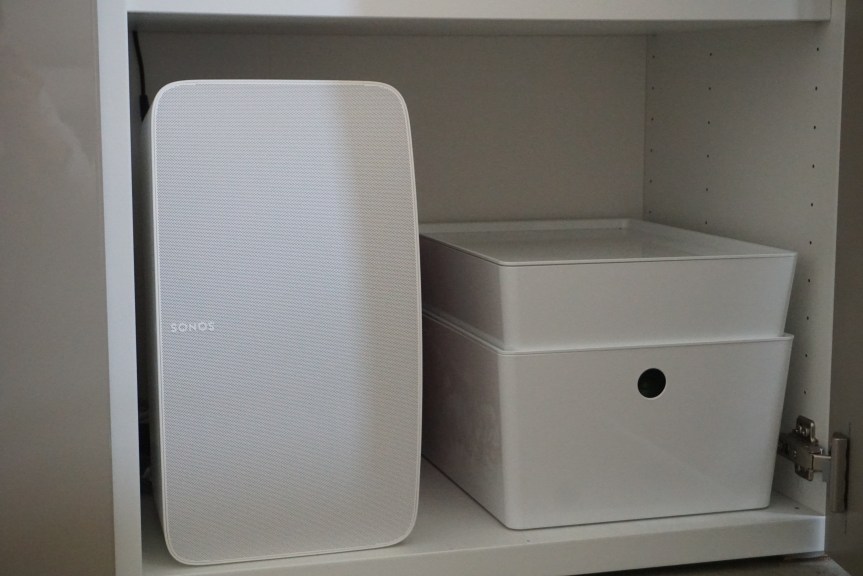
The biggest thing we hide are our white Sonos 5 speakers. (affiliate link) I despise tech for its wires and unsightly bulkiness, even though I love tech for all the things it allows us to do. It’s a necessary but ugly thing – so my one requirement for speakers was to be able to hide them. The small size fits perfectly in our Ikea Besta media console (we have the combination with white doors/Stelsviken/Stubbarp/High-Gloss/Beige combination with a glass top and without the legs on). The sleek appearance of Sonos displays beautifully, making it okay for me to leave the doors open when it is in use. I love how the white color option really matches our home’s Scandinavian style. My husband enjoys the sound quality of Sonos speakers, and it has been so nice adjusting the volume and playing music from Spotify using our cell-phones. I love playing music from the kitchen island while we cook meals together on the weekends. It also easily connects to our record player and projector via Wifi.

The second thing I hide are all of my notebooks and binders. I use Ikea’s White Tjena Magazine Files to keep non-white colored books hidden. I first saw this tactic used in the Kinfolk Home book. I loved the way you could keep cabinets and open shelving clean, while having my most-used recipe books at-hand at all times. The file boxes are very sturdy and have a notch at the end for easy movement and grabbing. These boxes are sold in beige and black as well, in case white doesn’t match your style. As for the collection of books that have white or black bindings, I display those openly within the cabinet. These books include our Kinfolk collection and Drift magazines.

In this console, we also hold some Ikea boxes from Ikea’s Kuggis collection. This collection has a number of white boxes in different sizes. I use them both in the living room and in the bathroom. One larger box holds my desk supplies, including pens, hard-drives, envelopes, stamps, and paintbrushes. A smaller box holds Mike’s cables and other tiny trinkets. These boxes come with lids and have a circular cut-out akin to the Magazine files, which makes grabbing and moving them quite convenient.

We placed the record player in the center of the console and hide the records in the middle cabinet. I specifically chose the middle cabinet because using the speakers require the left and right cabinets to be open. I couldn’t find a white container that was big enough to hold the records, so I did what I could and hid it where it can stay hidden. Along with it are the main power plug, the cables that power the speakers, Mike’s Switch console and charger, and his gaming controller. The unsightly things go in the cabinet that stays mostly closed.

I make it a point to keep the doors to our media console closed unless we are using our Sonos speakers. This makes it easy for me to “tidy” the space. In photographs, it makes the living room look polished at all times. When guests are over, the clutter stays out of the way. Even if we play music for dinner parties, the white boxes and magazine files give the living room a cohesive look. I know not everyone shares my neatnik tendencies, but for those who do, these are some of the ways I’ve learned to cope with messiness. I’d love to hear your own tips and tricks!

How to Organize Kitchen Drawers with TokoDesign

This post may contain affiliate links. Please see my disclosure to learn more.

This post is sponsored by TokoDesign, a new modular minimalist company fabricating eco-conscious organizers for messy drawers. The name “Toko” comes from the Japanese word ‘tokonoma’, which describes a special alcove for displaying art. As I’ve alluded to in other posts about the home, I believe that our homes should be artful representations of ourselves. I am all about letting the furniture do the decorating, substituting architecturally historic or artist-driven products for hanging paintings, sculptures, or other traditional methods of home decor. By being mindful of the products we allow into our home, we can create art using house items that are equally functional and beautiful. TokoDesign plays an ode to those ideals – mimicking the emphasis on minimalism, versatility, and natural beauty in traditional Japanese interior design. TokoDesign has gifted me a set of organizers so that I may try it out myself. As always, this review and the opinions held within are my own.


I have a secret about my home, and that is, that it’s incredibly messy. However, I have tricks stashed up my sleeve to make it appear clean, neat, and minimal on social media and to my friends and family who visit, one of which is quite simple to do. I create the illusion of tidiness and sparsity by putting things behind closed doors. It doesn’t help that we have a shortage of doors at our home, living in a live-work loft open floorplan that has no door to separate our bedroom nor our bathroom from the rest of the space. It also doesn’t help that our space is tiny, in general.

Even though I don’t own a lot of things compared to the general public, the limited hiding places and my desire to hide everything from plain sight means that our few items still get a bit crowded. One of the banes of my existence are the kitchen and bathroom drawers. Filled to the brim with accessories, utensils, and gadgets, my items get jostled around with every opening of the drawers. Some people find the solution in placing cooking utensils in a beautiful holder on the countertop, but I have this insane itch to keep counterspace clear.

Luckily, TokoDesign has come to my sanity’s rescue. This minimal, modular organizer is probably the best organization tool I have come across since Marie Kondo’s Spark Joy book was published. The wood is made from renewable bamboo and has a beautiful look to it. The rails come in either black or white, which works for different home styles. I personally chose the white, because the exterior of our drawers are a light wood color and the inside is white. I preferred for the rails to blend in rather than stand out (there I go again with hiding things from plain sight!). I can see the black rails working with more modern kitchen schemes, like Ikea’s charcoal grey cabinets, or dark wood finishes.

The design is thoughtfully made so that the organizer can work for different drawer sizes. My qualm with other organizers is the pre-determined dimensions and the need to find ones that exactly fit a space. The rails of the TokoDesign have adjustable lengths thanks to a knob that you turn at the end of the rail to make it flush with your drawer length. There are multiple length options and the width of your drawer will determine which dividers you choose. There are three divider widths available, and even if it doesn’t span the width of your drawer perfectly, the end section can still be used as storage, as I’ve done below.

The rails ended a bit short in my drawer but I used the last sliver of drawer to the right of my last panel as a compartment for rubber spatulas and a TDS measurer.

What makes the process even more fun is the accessories that TokoDesign has produced. Kitchen knives stack neatly in the knife block, cutlery lay neatly in the silverware trays, spices align on the rack, and tiny trinkets and bobbles stay contained in boxed compartments. A person has the ability to create the combination that works for them digitally on their online order form. You can visualize how the items you purchase will look in the drawer before you even order them. I really enjoyed playing around with the different combinations once can make. I was even able to combine TokoDesign’s boxes with my pre-existing bamboo silverware tray, and it blended perfectly!

The versatile box system went well with an already existing bamboo cutlery tray that I had sitting in this drawer. The boxes now hold a number of small items such as our chopsticks holder from Notary Ceramics, my limited number of pipette tips and clips that we use to close coffee bags or chips.

Of course, I used TokoDesign for the drawer that gave me the most grief – the kitchen drawer that holds all our cooking utensils. However, I can see this system working just as well in the bathroom drawers, work desk drawers, and even nightstands. For women who have a lot of jewelry or makeup products, the boxes could prove quite useful for showcasing your favorite things in a way that makes you proud to open your drawers.

Ever so grateful for companies who implement zero plastic packaging.

They ship everything with as little plastic as possible, by the way. Only the side rails were wrapped in a thin sleeve to prevent scuff marks. All the divides and boxes were packaged without plastic, and the big shipping container in came in was also without plastic. I was so excited when the package arrived that I opened it immediately and started playing with the dividers right away. It seriously felt like a new toy on Christmas morning, which goes to show the extend of my OCD. It was easy to set up and assemble and it requires no tools to do! Most importantly, it really stays in place and nothing slides around. When I was finished playing with my TokoDesign, my drawer truly sparked joy.

The final product! Now things stay where they belong and are grouped by similarity in function. The middle tray, for example, are the items we use most when we make cocktails. The whisks are together, as well as the rubber spatulas and can openers (yes, we have two, a friendly reminder that minimalism isn’t a state of perfection.)

My Minimal Work From Home Desk

This post may contain affiliate links. Please see my disclosure to learn more.

Small Space Living: Tip #16: Choose a Minimal Work-From-Home Desk

Creating my ideal from-home workspace has been a long and arduous process. My intentional habits tend to get in the way of progress as I am quite particular in the function, overall look, and general meaning behind each item I introduce into our home. Couple that with my tendency to talk my way out of purchasing things, and it becomes easy to see how I get in the way of myself. It’s all migraine-inducing, but I finally feel like we are getting somewhere.

To say that we haven’t quite come to grips with our final WFH environments after a year-and-a-half into this WFH state does sound laughable. To be honest, I’ve been making do with the kitchen table, eventually upgrading to a tiny $50 Ikea Micke desk. My husband was holding meetings and conferences in our bedroom, and yes, it has been odd having no doors in our home to create any sort of privacy. In order to talk to someone during Mike’s workday, I have been stepping onto our balcony and shutting myself out, imposing my conversation on our neighbors, while the streets around us impose their city noise. We ended up getting Herman Miller chairs sometime earlier this year, and by doing so, cluttered our bedrooms and living rooms respectively. However, with the advent of our roommate moving out at the end of August, we reclaimed the downstairs space which we are now turning into Mike’s permanent WFH area, after the company’s recent extension of remote work.

Meanwhile, I’ve moved from my dark nook in the living room to the bedroom, where Mike used to be. And with this new location comes a bright, shiny new desk. Well, shiny to me, but in reality, it’s quite humbly muted. I upgraded to the ever iconic Work Desk (affiliate link) from the Swedish company, String Furniture, and I must say that I am beyond excited about this improvement.

Famous for the modular system that they created in the 1950’s, the work desk is made up of rails and a large, hanging platform. I chose beige for the rails paired with a classic white desk. Positioned right next to three window panes that look out to the downtown streets below, the rails allow plenty of light to pass into our home and my workspace, where many plants reside. I made sure to position myself right beside the windows, so that I may look out and daydream, as that is part of a writer’s job.

The entire desk took three months to ship from Sweden but came packaged in two thin boxes, lighter than the desk from Ikea. I could lift both boxes easily. Essentially, the desk is founded on the two light-weight side rails mounted to the wall by four nails. The desk sits on four pins hooked onto the rails. The height of the desk can be changed so that it can work for a child as well as an adult. The back bar for the desk holds the platform down, locking it into place.

This simple design and easily shipped product is the reason why they won the national competition in Sweden in 1949, and why they have been classified as Applied Art under the Copyright Act in 2009. So yes, the desk is a piece of artwork itself. This is something I have been trying to do in my home – that is, adding art in the form of furniture and design, rather than the traditional painting, print, or sculpture art. In essence, this is a way for me to add beauty AND function using fewer pieces, thus maintaining minimalism in the home. Let the furniture do the decorating.

String Furniture hasn’t just made a desk, by the way. This modular system was originally designed to produce a shelf (affiliate link), which once decorated the UN headquarters in NYC in the ’50’s and which became the best-selling Scandinavian furniture in Germany in the ’60’s. The shelf has turned into a system that can also be a nightstand, media console, desk, dining table, and kitchen cabinetry.

In true fashion, I’ve ordered the most minimal combination. The rails are floor panels that only reach halfway up, contrary to the original desk design that used panels that reach higher to place shelving above. I have the desk without the drawer as well, just the platform on which to work. Eventually, I would like to put a small filing cabinet in the 12-inch space between the desk and the wall, and I’ve got my eyes set on this one by Branch furniture. I want a filing cabinet that triples as a drawer, a paper organizer, and a side table as well.

Having the desk situated by the windows is useful as the sill doubles for a place to stack my planners and notebooks within arm’s reach. I also charge my phone on the sill at night, further away from my bed, which is a habit I’ve adopted a few years back to create distance between my phone and I. Meanwhile, my desk mates consist of plants which surround me on either side, adding a bit of life and fresh air to this space. Most of the plants I own are gifted, some from The Sill (affiliate link), a company that ships plants directly to your door, pottery et al.

I’ve also loved my Herman Miller chair but I recently saw this modern, ergonomic option by Noho Co (affiliate link)., and have been contemplating switching out my wheels for a more grounded sitting situation. The going is slow in my space but I am so happy with the current state and what I’ve put together so far.

My daily coffee mug is from Hasami Official and the water glass is Pokal from Ikea. The linen coaster is from Fog Linen.

I also wanted to share with you the contenders I had for desk options, in case you don’t love the String desk but are also hoping for your own minimal desk upgrade.

My favorite, runner-up desk options.
  1. Copenhagen 90 Desk by Hay (affiliate link)
  2. Rail Desk by Menu Space
  3. Shelf Library System by Frama
  4. George Console by Skagerak (affiliate link)

How to Deal with Paper Clutter

This post may contain affiliate links. Please see my disclosure to learn more.

There is a really quick way to deal with paper clutter. That is, to get rid of it. As in, ALL of it.

Paper clutter used to be my biggest problem, next to books and clothes, although not necessarily in that order. But I’ve devised a system for dealing with paper clutter and it’s quite simple, really. Get rid of paper as soon as you can. Keep it out of your home. Digitize it and then begone. Keep a filing system for only a handful, and declutter it twice a year. Paper can become really agonizing and stacks up quite quickly without us realizing it. Have you ever tried to shred ‘important documents’ before? If you have, then you’ll know.

I recommend the following:

Don’t take home flyers.

You know, the one they hand out at events or stick to your windshield? Or worse, the business cards one may pass along to you. I know it’s hard to do, but practice saying ‘no thank you’. For those sneakily slipped beneath my windshield wipers, I find a public trash can right away.

Unsubscribe to mail.

Mail can get a bit unruly. The trick is to limit the mailman’s load. Unsubscribe to all magazines, flyers, companies, etc. Even the non-paid subscriptions are a hassle. I’ve found that these companies somehow regain access to my address and weasel their way into my mail box. I just keep calling and telling them to put an end to it. Do you really need to look at more of the things they want you to buy?

Go Paperless.

Almost every company has a paperless option by now. When possible, we choose paperless. The reason being, these companies are usually the ones that send account information home. Bank accounts, electric bills, and mortgage updates – all paperless for us! The reward is two-fold; less chances of someone else getting access to your information, and less mail to sort through and shred.

Open mail right away, sort and discard.

The most common thing people do when they get the mail is put in a basket ‘for later’. Man, what an eyesore! We don’t even keep a basket. Mail that gets brought in is looked at and discarded ASAP. Those that have tasks associated with them (making a payment or appointment) are completed as soon as possible which kills two birds with one stone – it gets the job done and it clears the table of hideous mail. Voila!

Digitize, whenever possible.

This, I had a problem with for a long time. I was quite fond of paper, even though this post wouldn’t hint at it otherwise. My class notes I kept after college. Letters from friends in middle school were tucked away in a drawer. I have essays that I wrote once, diary entries meant just for me. All of that is now gone. I realized that the more I threw away, the easier it was to let go. For those I couldn’t bear to part with, I scanned and digitized. Since scanning takes work, I decided it would behoove me to be very selective, but also, to vow never again to collect as much paper as I did. Call it a lazy person’s curse, but I hardly wish to keep paper things anymore.

Keep the most important pages in a filing cabinet.

There are a few papers that you can’t digitize, then throw away. My degree, for example. My license. My naturalization papers and my passport. These we keep in a filing cabinet. My motto is: Out of sight, out of mind. This one is my favorite minimalist option, although CB2 has a number of options, too. Pro tip: Declutter twice a year to prevent stock piling. Perhaps what you once thought was necessary no longer feels that way after de-cluttering.

Photo by Brandi Redd on Unsplash

Simple Things: Dressing Up Tables

This post is sponsored by Piglet in Bed. They make linen bedding as well as tableware products, and they have made my natural linen tablecloth dreams come true. I chose an oatmeal hue to match our charcoal gray linen napkins, gifted to us on our wedding day. The linen tablecloth is made from natural stone-washed French flax, and are absolutely soft. They haven’t yet shrunk, although as a general rule of thumb, I hang all my linens (napkins, couch covers, bedding) to dry.

I am not one for frills, but I occasionally dabble in dressing up tables for the sake of adding a little extraordinaire to our otherwise simple and mundane lifestyle (not at all insinuating boring or sad – we are quite happily mundane after all). And when I say dressing up tables, I duly mean throwing a textured linen tablecloth over the well-loved, heavily dinged farm table that we salvaged from our wedding, and then calling it a day. Or rather, an indoors picnic, a festive party, et cetera. I festoon upon said linen tablecloth all the ceramic pottery we own from our ever-favorite, East Fork Pottery, and the traditional cafe glasseware that I bought from Ikea, having upgraded my water glasses with a spare $20, after drinking from hand-me-downs for over a decade. We really are on the come-up.

Jokes aside, I count the linen tablecloth as a necessity in a minimalist’s arsenal – not because I feel like tables must always be dressed, but because it is a nice way to switch the look (and feel) of a space without having to buy an entirely new table. To think that folks of my generation and age-group don new dining tables in a similar fashion by which they don new clothing makes me, at-once, weak at the knees. Forgoing all of that in lieu of paying back student debt quicker, I rely on what my mom’s generation used to make mess-cleaning easier. What once was a brown setting is now a rustic bone. Tablecloths stash quite nicely, folded, in the tiniest spaces, and look just as good pulled from their hiding in all their crinkled glory as they do ironed and steamed to perfection. That, and the argument that linen tablecloths are multi-functional and earn their keep in our already tiny home.

Here, a repertoire of all the things tablecloths can be.

  • A vintage linen blanket on a bed. Parachute ones sell at over $200 a pop.
  • A picnic rug, if you don’t mind the grass stains.
  • A backdrop for still-life photography.
  • A means for an escape route from the second story, in case of a fire.
  • A make-shift curtain, to separate spaces or to keep nosy eyes out. Erin Boyle shows the way.
  • A hammock for a cat (we have yet to try this one out).
  • A knapsack for all your farmer’s market finds.
  • A rug, for when you want to repot your plants but wish to make the clean-up a tad easier.
  • An outdoor canopy on a small-city balcony.
  • A couch cover, on days when you dog-sit.

And when it’s lived it’s last breath, here’s a few ideas of what they can become.

  • A table runner, if only a portion is left unstained.
  • A set of napkins, cut into squares and sewn around the edges.
  • A patch on a quilt, because linen quilts have made a come-back.
  • A number of dish cloths.
  • A bib for toddles and babies.
  • A shirt, if you know how to sew.
  • A scarf, because it’s just the right length.
  • And lastly, fabric for a re-upholstery project, perhaps on a dining chair?