Simple, Sustainable Gift Wrap

I am not one to take in an eye-sore kindly. I would call that one of my biggest flaws. Things just have to be aesthetically pleasing to be pleasing to me. For that, I am sorry. So when it comes time to start putting presents under the tree, it follows that I cannot just shove them there, unwrapped. It isn’t that I feel the need for another person to be surprised, although surprises are quite nice. It’s that I need the presents to look cohesive, for my own sanity. Which brings me to the following dilemma: less waste for a time of the year when gifts abound.

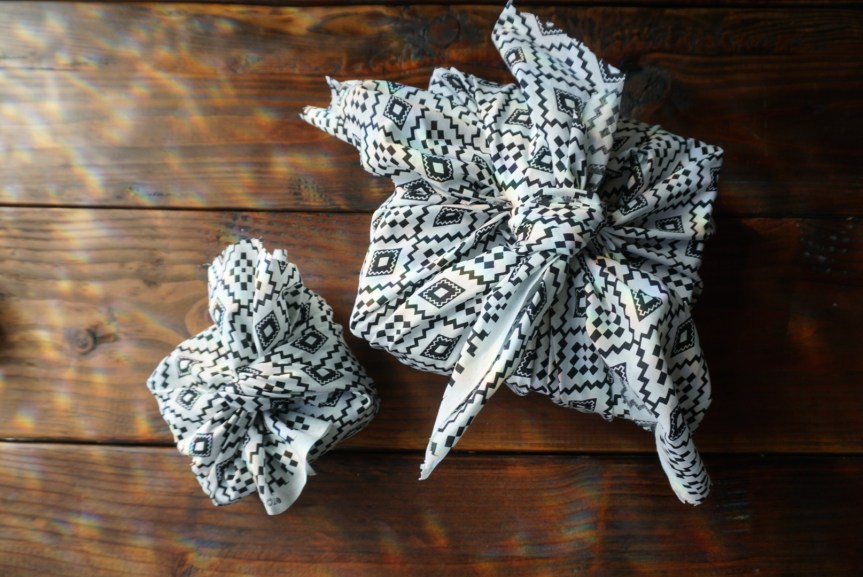
Last year, I wrote about the art of furoshiki gift wrapping, as a means to produce absolutely zero waste by using excess fabric lying about the house. But after a year has come and gone, I am without any more fabric left to wrap gifts in. It appears that everyone wanted to keep the fabric pieces for their own re-use. This year, I find a not-so-perfect zero waste (zero-ish waste? less waste?) solution from the following:

+ Less gifts, in general. Call me Einstein, but with less gifts comes less gift wrap, and therefore, less waste. This year, I have narrowed down our gifts to ten. That includes required Secret Santa’s at work and holiday parties, and our most immediate family members. Part of this comes from our public renouncement of the gifting of material things, right this way.

DSC09379

+ Simple methods of wrapping. One of the very first memories I have of being conscious of my wasteful lifestyle involves wrapping gifts at Christmas time. I was 20 years old and I had volunteered to help my aunt wrap the gifts for my cousins (all forty-something of them). I was previously taught by my mother how to make gifts look pretty by adding in additional folds in the wrapping paper and using multiple bows. By scrapping sticker tags when my hand-writing was too ugly to bear. I went about my usual methods of wrapping gifts when my aunt questioned why I was folding the wrapping paper in such a way. I replied, “Because it looks pretty.” To which she laughed and said, “It wastes paper.” Confused, I didn’t understand why that mattered. Off course, my mind mulled the comment over and over again in my head as I continued to wrap. By the end of the wrapping session, I was embarrassed at the waste of gift wrap that I had cost my aunt. I was embarrassed of my frivolous lifestyle. And I saw a glimpse into the world of minimalism that I had yet to discover. Nowadays, I just wrap the paper once around, barely enough to cover the good, and call it a day. A more refined self finds this way of wrapping more attractive anyway.

DSC09365

Simple materials. I avoid plastic as if I was allergic to it, that you may already know. These days, I find comfort in choosing materials that are natural, biodegradable, or at the very least, recyclable. For Christmas this year, I’ve stuck with twine, string, paper wrap (the non-glossy kind), brown boxes, and re-usable stamps. The color scheme itself is simple, making it easy for me to satisfy my need for cohesiveness. To fill excess spaces in the boxes, I’ve opted not to purchase tissue paper, but rather, use left-over packing paper that has survived our move into our new home a few months ago.

DSC09370

+ Less wrapping of the gift wrap themselves. If I have to buy gift wrap in order to appease my need to have everything look cohesive, may it be the least-dressed gift wrap there is. This tip goes out to the minimalist (or minimalist hopefuls), to the environmentalists, to the pursuers of mindful living. This year, I went to a local stationary store (and by local, I mean I live across the street from it), and chose a brown paper gift wrap rolled up sans one of those cardboard rolls that you typically find in the center of a tootsie pop wrapping paper. Additionally, it was not wrapped up in cellophane, as they usually are. It was held together by a piece of paper detailing the company from which it came. I also purchased paper tape, with a little green decorative charm, holiday-esque enough to spruce up plain brown boxes (see what I did there?). I purchased yarn that was wound around a cardboard roll, and without the plastic covering (why are they even necessary?!). Lastly, I whipped out my wooden stamp collection and cut up a piece of sketch pad paper to make the name tags. All of this to say, it doesn’t take much to appease my need for pretty. We don’t have to indulge our presents in excessive gift wrap, but I am completely okay with allowing myself something simpler. It’s not perfectly zero-waste, but we can’t always be beating ourselves up for their inabilities to be perfect. We are, after all, human. The point is, we try.

DSC09385

DSC09366


Using Gifts to Talk About Mindful Consumption with Younger Generations

When was the first time you were introduced to the concept of gifts? If it’s like most people, it was likely at an age when you were not yet capable of comprehending what a gift was! Growing up, we all were taught to expect gifts and to ask for things, even when we were too young to expect anything at all. From our very first birthday, we were taught that gifts come hand-in-hand with any celebration. Aunts and uncles would ask for wish lists, and parents would prompt you to write a letter to Santa. In this sense, gifts were one of the first factors in propelling our lifestyles towards one of consumption. This Christmas, I implore you to change the way we talk about gifts with children.

ON TALK OF GIFTS:

Instead of asking children what they want to receive for Christmas, ask them what they want to do. Avoid the talk of gifts all-together. I ask kid patients who come into the dental office what they have done thus far to prepare for the holidays rather than ask them for their wish list. If a child says, “bake cookies”, I ask them if they plan to give some to their next-door neighbor or friends at school. If they say “write a letter to Santa”, I ask them if they are also going to write a letter to their sibling, telling them how important they are. If a child brings up gifts, I ask them to tell me the one thing they have in their life right now that makes them feel most gifted, whether that’s their family, their warm bed, a hobby, or a special moment.

ON WRITING WISH LISTS:

If you are writing a letter to Santa as a family, perhaps challenge a child to write only ONE material item that they “want”. I am not saying deprive a kid of STUFF. I am simply saying to limit how much of it surrounds them. Your child likely does not need a dozen more toys. A statistic states that the average child in the developed world owns more than 200 toys, but plays with only 12 of them on average a day. Additionally, the US children make up 3% of the children in the world, but owns over 40% of the toys in the world. So as a non-mother, I do dare say that your child should only ask for one material item. My suggestion? Ask them to request experiences instead. Perhaps your child will ask for their favorite meal, or a venture to the movie theatres. Mayhaps they ask to adopt a pet, or to spend an afternoon helping others at a soup kitchen. Maybe they’ll ask to see far-away grandparents this year, or for world peace. Children are so brilliant when it comes to ideas. They may surprise you, let alone Santa.

ON CONVERSATIONS ABOUT CONSUMERISM:

If you ARE gifting kids something, start a conversation with them about where their gift comes from. Let them know that their item affects the environment, and the people on it. Tell them how. Spend some time with them researching who made the gift, and what purchasing the gift means. It’s important to have them understand that things do not just magically appear from the sky, even if Santa does. In knowing this one simple fact, they will become more mindful about the source of everything that enters their lives, rather than dismissively assume that our consumption has no effect. In doing this, we can raise children with enough awareness to question.

ON MINDFUL GIFTS:

There are many ways to start the conversation with mindful gift-giving.

  • Fair + Simple launched their Fair + Little line this year. The collection consists of curated goods hand-sewn by women in the Philippines. Each gift is meant to change the way children views stuff. There is a card for every purchase, telling the child a little bit about the maker, and how the gift helps others. There is also a call to action that prompts each child to get out in nature, and become treasure hunters. Inside the pockets are hidden treasures from the founder, Molly. To learn more about Fair + Simple, check out my interview with the founder.
  • KrochetKids has a collection of children’s knitted goods, ranging from beanies to stuffed animals. Each product is hand-signed by its maker, thereby opening the doors for you to tell them that their items are made by hand by a human being, not a machine. You can also have them write a Thank You letter to their maker, and send it to them online!
  • Farmer’s Market and Artist Fairs are great ways to have a child actually meet the hands behind their gift. They can even speak with the maker and ask them questions, such as how they got started making these things and what was the hardest part about its production.

An Advent Calendar for a Slow Holiday Season

When we were younger, we would go to the grocery store with my mom and see advent calendars up for sale. I would beg my mom to get me one, excited about the promise of opening a chocolate-filled container every day until Christmas. But my mom would refrain, telling us that we have chocolates aplenty at home and we don’t need a calendar in order to eat it. Still, I would think to myself, what a wonderful way to spend the holiday, looking forward to a little self-indulgence once a day in anticipation of Christmas morn.

Needless to say, nowadays my concerns aren’t centered so much around chocolate as they are about intentionally living each day to their fullest. (Well, sometimes they are.) Yet, living with less is a form of indulgence in-and-of-itself. How many times do I see people at the mall in angry moods, stressed by a floor-length gift list, or families rushing to check off boxes on their holiday to-do list. Put up the lights, check. Wrap the gifts, check. Pictures with Santa, check. Write the letters and bake the cookies, check. Order the holiday cards and mail them, check. It is this time of year especially that I am aware of the ways in wish we constantly fill our lives and rush through the days, missing the season completely. As with most things, we spend our lives looking to the future, and by-passing the present entirely. Therefore, my efforts are concentrated around my only goal for the holiday season, which is to simplify it.

Along those lines, I love the idea of creating an advent calendar that is constantly reminding us to take it slow. Ironically filled with activities to-do galore, the calendar is meant to insert an activity intentionally bringing us to the present. Each card details either a way to connect with others, to do good, or to wind down. And let’s not forget activities for ourselves, too. A little self-love in the form of mulled wine. Or a coffee date with a loved one.

Off course, the calendar isn’t meant to be rigid, which would add another stressor in our lives. Numbered one to twenty four, the fulfillment of said activities need not be done in sequential order. Think of it as a mere suggestion. If it’s rainy today and a walk in the neighborhood will surely bring displeasure, then swap for a different activity. If two activities sound great on the same day, then maybe double up. Skip one after a long day of work. The intention is not to add another check box to the list. Simply, it’s a physical reminder to be here.

Additional points if you create the advent calendar with the rest of the family members, like we did. (As you can probably tell when you get to activity #22.) Enjoy our suggestions, and I hope you have a few great ones, too.

  1. Watch a Christmas movie together as a family. We’ve already done Home Alone with my brother and roommate, but there are more classics to be seen. My personal favorite, How the Grinch Stole Christmas.
  2. See the lights at the Newport Boat Parade. We usually bundle up in our coats and gloves and beanies and stand on the bridge leading up to Lido Island as we watch the boats float by. Waving to the occupants, optional, a warm mug of hot chocolate is not.
  3. Make Christmas cookies. Sugar cookies and snickerdoodle are fun, but chocolate chip will always be my go-to.
  4. Deliver cookies to neighbors. Because we don’t know our neighbors as well as we should.
  5. Put up the tree and decorations with family. Re-living some childhood mems, we have invited my parents and brother over to join us in putting up the tree. In the interest of frugality, my parents have lent us their old 9 foot tree to put up in our home, lights included.
  6. Group gift wrapping event. It’s more fun when you wrap gifts with others, rather than alone. Instead of a chore, make it an event. Invite some pals, serve cheese and bread.
  7. Cover a Christmas song with Mikey. This requires a bit more time, and patience, on both our parts. Letting others hear the end product is up to you.
  8. Take a walk in the neighborhood to look at the lights. Every year, my parent’s neighborhood has a light contest. It’s a pretty big area, and it would likely take a few hours to walk a decent amount of it. But we’ll make the time.
  9. French Toast breakfast, for dinner. Or for breakfast, up to you. Add a smear of persimmons, perhaps.
  10. Coffee date at our favorite coffee shop with sketchbooks for sketching passer-bys. This is a true indulgence, one that requires spending. It’s been a while since we’ve ordered coffee out, what with No-Dining-Out November barely behind us. I’m sure our barista will welcome us with open arms.
  11. An evening dedicated to reading. If I could do an entire day, I just might. It’s been a while since I’ve been able to pick up a book and finish it on the same day!
  12. Bake home-made croissants for a local office. I was asked to bake my home-made croissants for an entire office team back in July. I’ve put it off for a while, because it is a lot of work. But when the croissants got mentioned again at Thanksgiving, I thought, what a perfect way to spread holiday cheer. So I will be spending a weekday off baking for others.
  13. Bake a pie. I have never made a pie. But I want to experiment using our bread. I am taking filling suggestions, if you have some.
  14. Make mulled wine and relax after a long day. In Germany when we were walking the Neuschwanstein castle with our friends, they brought us to a stand and ordered us some Gluwhein. Mulled wine is a common drink during Christmas time in Germany and Austria, served piping hot steeped with fruit and topped with a big of sugar. The perfect way to decompress after a long day.
  15. Make hot chocolate and take an after-dinner walk. Sometimes, after dinner, we just get in that mode of clean, wash, and lounge til bed. I really want to make the effort to step outside and just take the night in.
  16. Make Christmas cards and send via email. We make our Christmas cards digitally, and send them via email, to reduce waste and postage costs. Typically, we flip through the past year’s photos, making this a great way to reminisce on our best moments, as good as the day they were taken.
  17. Spend an afternoon playing boardgames. Because who doesn’t like a little friendly competition?
  18. Have a bonfire at the beach. Mike has been wanting a bonfire since the summer days. It’s time we actually do it, and bring smores along, too.
  19. Go on a hike. Get a breath of fresh air.
  20. Declutter and make space for the new year. In fact, make space for the now.
  21. Turn up the records. Neglected the past couple months, sitting on a shelf, it’s time to give em a little love. Listening to a vinyl is just way different than asking Siri to turn on Spotify.
  22. Make milkshakes and race to see who can drink them the fastest. To use a straw, or not to use a straw?
  23. Light a candle. Avoid turning on the lights. Add a little hygge and eat by candle light. Better yet, write by candle light, with paper and pen!
  24. Gather with friends. The generic-ness of this statement reflects the difficulty, as this is the busiest time of the year. Snag moments whenever you can.

Other ways to practice slowing down for the holidays.

  • Write down one thing you’re grateful for every day and put it in your stocking. Read all your gratitudes on Christmas day.
  • Put limits on everything. Limit the number of gifts you get, the number of parties you attend, the amount of minutes on your cell phone. Replace with moments of silence for a peaceful holiday.
  • Create a children’s book advent calendar.
  • Call old friends and far-away family members on the phone. Just to say hello.
  • Pick up good habits. Greet everyone you pass. Look at people in the eyes. Put away cell phones during social interactions. Say good morning every morning, give your loved one a hug every night.

Writing A No-Gifting Holiday Letter

My favorite time of year is upon us. A time of brisk morning air, evening fireside chats, excuses to snuggle and wear socks to bed, and gathering for no jolly good reason at all except for the fact that it’s that time of year. Intermingled among all this is the season of gift giving, interlaced with all sorts of well-meaning intentions designed to show affection and care. How then, to break one’s bubble and tell them not to give gifts at all, in order to avoid waste, excess consumption, and negatively impact livelihoods and the planet? Such Grinch-like talk will surely get you uninvited to Aunt Sally’s Christmas dinner. But lack of such talk could keep you in a cycle of forever contributing to unnecessary waste production and consumption. Which idea can you be more at peace with?

For myself, preceding any sort of wish list requires a conversation, which could be substituted by a letter if you’ve got some ‘splaining to do for a large number of people or if the face-to-face interaction is just too awkwardly painful to sit through. It requires bravery fortified by resolve, THAT I can guarantee you. It also requires an openness on my part, since I have no control over the openness on their part. Meaning, I must accept the possibility of rejection. For some, gift giving is just something very much ingrained in their being. I know it once was the case for me. There used to be a time where everyone I knew got a gift from me, whether they wanted to or not. I used to think it was the best way I could spread joy and show love. Today, I see the holidays as a heavily marketed event that promotes large amounts of consumption packaged in the form of gifts. Not everyone shares my view point. But I know that I’ve changed, and maybe over time, they may too. Regardless, allow people to be themselves. It is important to share your view point and stand strong as a mountain around your values, but it is equally important to allow others around you to be fluid and flow as a river, going their own way. Be open to being denied your wish to veer away from gift giving, because it is, after all, a wish.

The hard part, off course, lies in finding the best way to communicate that wish. Each family is different, and the way you communicate greatly affects the way the wish is received. With my immediate family, I have had endless conversations (throughout the year) about my stance. But what of extended family and friends? The easiest thing to do if your family is keen on sending each other wish lists is to include a letter addressed to all. Every year, people ask me for a wish list. And when I say “You don’t have to get me anything”, they typically respond with, “Just send it to me, anyway.” So I do, attached with a written letter. I have included this letter last Christmas, for my most recent birthday, and yes, this Christmas as well. May you find inspiration and support.

Dear all,

Please do not feel the need to get me a Christmas gift this year. I’d rather Christmas be about spending time, not money. I am more than happy to receive NOTHING. Actually I would feel a weight lift, since I feel stressed knowing that our consumption choices do affect the environment. Our resources could be used elsewhere, like buying a Christmas meal for a low-income family, or sending the gift to a child in a third world country. Please consider.

On that note, if you cannot keep yourself from the gift giving spirit, I ask that you kindly respect my wish for having as little negative social and environmental impact as possible. I request no plastic packaging, which requires either picking up these items from the store or writing letters to the companies to request zero plastic packaging in the shipping. No gift wrap is necessary, but if you wish to wrap, please be mindful and avoid plastic wrap, including ribbons and bows made from cellophane. There will be no need for plastic tags stickered onto gifts as well. Lastly, please use the links specified in this document if you choose to gift. Do not substitute products with other products as a majority of these are chosen specifically for their sustainability in material, fair trade, or direct global impact in poor communities.

Future thank you, regardless of what you choose to do.

XOXO,

Sam

Yes, it takes guts. Yes, it may not be well received by some. But after sending letters of the like twice before, here is the change that I am happy to see.

  • This year, my siblings were open to limiting the gifts to under $25. We used to spend $100+ on each other, and limiting it to a small price really allows us to focus our dollars on what we truly need.
  • This year, my sister-in-law approached us and asked if her, Mr. Debtist and I could skip gifts this year. She said that she had also asked her closest friends to do the same, and it was received with open arms. She only felt comfortable asking us this because we have made it clear in the past that gifts are not important to us. The conversation had already been started.
  • We have requested to participate in only the Secret Santas for the parties we are attending. Meaning, for the years that we are attending the other side’s extended family’s party, we will be skipping gift giving for the side we aren’t attending.
  • My husband and I will not get gifts for each other. We gift to each other throughout the year in forms of travel, quality time, and everything else we do to create an intentional lifestyle. At the end of December, we will be traveling to Australia and New Zealand, which is “gift” enough.

I hope that in sharing these moments, you find the courage to speak up for the lifestyle you want to lead. Change can happen, no matter how minute, but it all starts with awareness about how our actions today affect the world we create for tomorrow.

Intentional Living: Produce Twice, Consume Once

I would like to start the conversation by saying that I am not entirely against consumption. I am only against excessive consumption. This doesn’t solely allude to buying, or consumption in the physical sense. It also refers to the immaterial, such as the way we consume media and the way we spend our time. In an effort to live an intentional life, I implement a simple rule to combat this tendency: Produce twice, consume once.

Related Posts:

Excessive consumption does not refer to us consuming more than we need, but rather, consuming at levels that are NOT sustainable. Our resources are finite. While it’s easy to define it in terms of material goods, how can we delve deeper in aspects of our life that involve intentional living? The easiest way is to analyze the way in which we spend our time. Do we pile on too much stuff on our to-do list? Do we waste time doing things that does not add value to our lives? We have limited time, limited energy, our souls have limited light. There gets to be a point where our activities are no longer well-sustained by our bodies. With resource depletion comes degradation and reduced health, which applies to us on a personal level, too.

Situated in an environment where consumption opportunities abound, I understand it can be difficult to resist the temptations of everyday, “normal” consumption. But the resistance gets easier with the awareness that we get mired down by the things that we own, and eventually, they begin to own us. The wonderful thing is that we have control over how much we consume. The greatest way to do that is to physically limit the amount of time we have to consume, by filling it with efforts to create.

Purposefully setting aside time in the day to do yoga, jot my thoughts down, make coffee, cook meals, practice guitar, learn a new language, et cetera, means less time to do other things. It’s funny too, but what I do with my life ends up shaping what I consume. As I delve more into getting my finances in shape, I surround myself with podcasts and books on personal finance. As I write about dentistry, I start to network with other tooth-lovers and learn more about the trade. As I make more cups of coffee and bake more loaves of bread, I consume videos and blogs that would improve my skills most. In essence, the goal is to snuff out wasteful activities. I am not advocating total elimination of consumption, but I think what you will soon find is that consumption can be healthy. It just needs direction, and creativity can be really good at directing it.

Like social media, excessive consumption is a self-induced societal disorder – an addiction that can rob us of the life we wish to lead. The question is, will you let it?

Try out my simple life trick. Creativity and production really are just as addicting as consumption. All of them give you that jolt of euphoria, but I’d rather limit the latter. Produce twice, consume once.

Intentional Living: Setting Boundaries

Once upon a time, when I was young and naive, I thought it would be most ideal to become the best “YES”-woman out there. That was my life goal. To take on the role of a fictional superhero, one that was capable of juggling a million things, and additionally, excel at them. I was deemed a bright star, but like all bright stars, I eventually burned out and, to some extent, was reborn. Existential notions aside, today I aim for a different life. One that is of a slower pace, one that has awareness with each step, and mindfulness with each passing thought. With this new life comes a new role, one that involves setting many boundaries.

Related Posts:

Intentional living cannot be achieved without knowing how to set boundaries. Have you ever felt overwhelmed by a to-do list, social obligations, or financial debt? All of this may indicate that you’ve bitten off more than you can chew, making it difficult to be intentional about any of your actions. You are doing so many things on such a short timeline, how would you have the time to consider what the repercussions and consequences of your actions are? How will you have time to explore alternatives? You won’t have time to think about what’s good for you, let alone what’s good for others.  Nothing about a fast lifestyle is intentional.

Some may argue that setting boundaries is selfish, but I beg to differ. Not having enough boundaries indicate a low self-esteem. Essentially, you are saying, “I am not important enough to be put first.” You spend your life trying to please others. I myself was once a people-pleaser. It made me extremely happy to make others happy. The problem was that my happiness was dependent on others, which was ultimately, destructive. It’s nice to make others feel good and to help others, but our own happiness has to come from within. Therefore, self-love is a key to happiness. Self – love is not equivalent to selfishness. Self-love invigorates us with life.

Off course, recently, I have been trying to separate boundaries from barriers.

Boundaries are always shifting, are growing with you, and are forgiving and kind. Barriers are definite, closed-off, and distancing.

Still, I struggle between the two, but I am learning. I have a tendency to require myself to show up and be accountable in terms of absolutes. I have difficulty allowing myself failure, allowing missteps and set backs. But once in a while, I am reminded of the need to be flexible, to mold with situations, and to move in a way that defines freedom rather than constriction.

Where to begin?

Know Yourself: You can’t set boundaries if you don’t know what you need. Many people have difficulty avoiding the stresses of the grind, because they don’t know what sets them off. When you are feeling tense, take time to identify the cause. Try to figure out how you can prevent it from happening again. Trust your feelings, honor them, and learn who you are and what values you uphold.

Select Your Crew: They say that you are only as good as the average of the five people you spend the most time with. While that may be oversimplifying things, it’s true that sometimes, we keep relationships that are negative. Surround yourself with people who build you up, who invigorate you, who make you feel passionate about something. Keep those who support  you. For those that are unaligned with your values, set boundaries, not barriers. One of the ways in which I have a tendency to put barriers up is by cutting out negative people from my life. It’s been for the better, but it wasn’t entirely kind. Additionally, cutting people out entirely does not allow room for growth, in either party. Even I can learn in this regard.

Limit Social Obligations: As an introverted couple, we exercise this more heavily than others. Social parties for us can be draining. One-on-one situations are better than group events, and shorter gatherings at home feel more comfortable than long weekend vacations. We know this about ourselves. I limit my social obligations because I know that I need time for myself, too. I let close friends and family know that we need time aplenty to mentally prepare, and to plan for a recovery period of recluse afterwards. It’s about knowing who you are.

Work Responsibilities: Work should never be taken home. That’s a rule that we practice in our household. Once we clock off, we respect our time to be spent with our loved ones and with each other. Once the lines between work and home start to blur, so do your priorities.

Web Surfing and Social Media: This is a recent one, but one of the utmost prevalence. Eyes have a way of gravitating to screens and hands have a way of reaching for phones. It’s like a magnetic force pulls us towards our electronic devices, and we must resist our ingrained tendencies. Setting aside specific times to use social media or surf the web is a great way to set boundaries. I try to limit use of Instagram to the morning hours on weekdays, before I head off to work. That includes using the Gram for blog stuff as well. I also have implemented the practice of consuming once, producing twice. Meaning, for every hour I consume media (whether that’s movies, videos, podcasts, reading blogs, and scrolling through social media), I try to spend two hours creating (examples of which include coloring, drawing, practicing guitar, writing on the blog, singing, or working on something else productive). What I’ve found is that the act of producing has this snowball effect that then fuels even more creation, which ultimately affects what I choose to consume. It keeps me from consuming random, unrelated stuff, but rather, I am spending my time learning about things I am working on. I consume other blogs that I could learn from, or music that inspires me to learn guitar. I listen to podcasts that motivate me with my financial journey. Et cetera. By allocating where I spend my time, I am also limiting what enters my life. Need help? Try these.

What I Need to Work On:

Mostly, I need to focus my attention on setting boundaries of the mental kind. Warding off worry, or negative perspectives of certain situations. Trying to grasp more control over my own happiness, by controlling the way I react to situations and people. Trying to be more fluid rather than rigidly standing strong. Despite all our trials, we need to keep our hearts warm. We need to remember the words of N. Waheed.

Stay soft. It looks beautiful on you.


Intentional Living: Logging off

My recent experience with an overwhelming amount of working days has lately made me extremely sensitive to the value of time. It seems that when time was of the essence, I made running amok as a chicken with it’s head cut off a daily occurrence. The imagery may be a bit vulgar, but it’s an accurate depiction of my panicked emotion. Now that I have more time on my hands, I am not of the inclination to use it wastefully. As in, lying in bed daydreaming, sleeping into the late morning, or scrolling through Instagram ALL DAY LONG. Those type of mindless activities would have been acceptable if my body was drained from the stresses of a crazy work schedule, but they are inexcusable when I’ve asked specifically for more time. Some things just shouldn’t be taken for granted.

So I’ve made quite the habit shift, specifically with the only social media platform that I am admittedly hooked on, Instagram. The habit: Logging off. Now, this isn’t to say I’ve completely deleted the app and forever forgotten about it. It has its usefulness which, mostly, is related to the workings of this blog. But it also has its wastefulness, specifically while I am sitting at work scrolling endlessly while waiting for my next patient. Or when I take a break from writing and slump onto the couch, phone in hand. An hour can pass by miraculously quickly when your head is in the clouds, up in cyberspace somewhere.

The habit I’ve created is this: I’ve allowed myself Instagram time in the first few hours of the morning, as I work on my blog. Anything I want to post is fair game, whether that’s recaps of the day prior, or anything going on the morning of. However, once I leave for work at 10:30am, I make an effort to not use Instagram for the rest of the day. Even on a day off, such as yesterday, I limited Instagram to only the morning. Which then forces me to create rather than consume. If I have downtime at work, I will type away on the blog. If I get tired of writing, I will pick up a book instead. If I am at home, there are endless chores that I haven’t gotten around to.

We detox our guts with diets. We detox our surrounds by de-cluttering. It’s time we detox our minds too. I would admit to a dependency on my phone. Embarrassingly, I would also admit to an addiction with Instagram. But that realization is the first step in getting our time back.

How have you curbed your social media time? I would gladly take any pro tips and what not. 


Intentional Living: Life Without TV

This post may contain affiliate links. Please see my disclosure to learn more.

It’s shocking to most that we do not own a TV. Neither have we ever. If you’ve been around this space for a while, you will know that it is partly due to my need to be minimalist. Having a screen around (and a large one no less!) to me seems a bit cluttered, unsightly, and makes me feel a bit like a character out of 1984. Additionally, they are heavy, expensive, and seemingly always upgrading to bigger and better qualities. As you all know, my life goal is to NOT spend my days keeping up with the Joneses.

Related Posts:

Why I do not watch TV.

Historically, I have not had any strong affiliations with the tele. I am every grateful to my mother for limiting my TV time to 30 minutes per weekday, and am also grateful for her ‘forcing’ us to watch whatever she wanted to anyway, aka DragonBall Z or Sailor Moon. By taking away the paradox of choice, TV became this thing that we simply did together as a family activity, and my fantasies laid with the many fiction novels I could choose to read, instead. It also helped that my tolerance for movies and television shows lied within a small range of genres, since I could not watch anything scary, suspenseful, or action-related, unless I plan on not sleeping that night due to my wild imagination and tendency to have very vivid imagery prancing around in my head. I also disliked a lot of grossly romantic stories, while documentaries in those younger years bored me. So I only had cartoons or comedy to entertain me. Instead, I filled my time with books, from which I got my fair share of crime and murder mysteries, classic novels, and sci-fi fiction. By the time I was in high school, my life was filled with so many extra-curriculars, that I was hardly ever in the same room as a television screen.

Perks of a life without TV.

Upon deep thought on the topic of having a TV versus not having one, there were many reasons that I came up with as to why I do not want a TV in my home:

  • Frugality: TVs are expensive. No joke, but TVs these days are so expensive. No wonder people line out the door on Thanksgiving night for crazy slick deals. That’s not the life I want! TVs can easily cost over $1k. For the price of a small sized TV, you can get a projector that has a screen that would probably cost you $3k or more!
  • Frugality: Cable is expensive. Part of the success we’ve had in paying down $550k in student debt is due to the ways in which we have decreased our recurring monthly payments. We have NEVER had cable. I doubt we ever will. I would rather spend those few hundred dollars a year on things that are more meaningful.
  • Everything is online, these days. If we want to watch a show, we will just log into Netflix and look to see what they have. Mike’s dad has a Netflix subscription, which gives access to the gramps and grams, the parents, and the kids. If you are looking to do a subscription, may I suggest asking around and seeing if friends and family are willing to share access? Most likely, you will find someone who won’t mind, or a group of friends who would be willing to split the costs. It seems a bit wasteful for every household to pay for their own subscription.
  • Intentional Living: Avoiding commercials and consumerism. This is a big one! Firstly, does anyone else get bothered when the program is interjected with little mini-breaks? It ruins the flow of the movie, the suspense of the series, or my train of thought while watching a documentary. Secondly, those mini-breaks are ways in which companies can stream advertisements into households that promote consumerism. Steady streams of ‘updates’ as to the products out there can only induce one thing: the need to buy. Lastly, hidden underneath those ads are socially constructed ideas about what is ideal. Subliminal messaging about gender roles, racial stereotypes, ‘covetable’ status symbols interspersed with not-so-subtle messaging about an ideal lifestyle. I would like to avoid that all-together. Nothing warms my heart more than when mothers in our dental office change the channels for their little ones every time commercials come on because they refuse to allow their kids to be influenced at a young and early age by such propaganda. Go MOMS!
  • Intentional Living: Avoiding the news and negativity. Of a similar token, I absolutely dislike the news. Why? Not because I prefer to live under a rock. But I find that the news contains a disparaging amount of negativity bundled up in reports. I actually consider much of the news as not news at all. I recognize that all news is biased. There are motives behind each minute. The job of the news channels is not to keep one informed but rather, to keep one watching. That’s the truth of the matter. I am not less informed by not watching the news. And I am not stuck sitting on a couch thinking the whole world is falling apart. Instead, I am actively learning by other mediums, and more importantly, actively trying to create change in the every day. Instead of feeling like there is no hope, I see all the positivity in fellow, active citizens. I am motivated by the change others make and inspired by groups of people who are creating a better tomorrow, rather than sitting at home watching a worse yesterday.

Reach Your Dream Life Faster Without TV

The most important perk of a life without TV is that it takes away from “wasted time”. If you are having trouble reaching your life goals or catch yourself mid-sentence stating again and again that you “don’t have time”, maybe it would behoove you to analyze where your time is actually going. That is the first step to fixing the time problem. I am not here to hate on TV, because this applies to a great many things, like social media and video games as well, but what I am trying to say is that maybe there IS TV time that we can cut out of life in order to achieve bigger, better, dreamier things. Here are a list of a few things that you can do in lieu of TV.

  • Experience new things, like traveling to some part of the world, or discovering some street in your neighborhood that you’ve never taken the time to walk through before.
  • Learn something new, like how to play an instrument or how to speak another language. Likewise, learn something new that will get you towards reaching your dream faster, like how to invest and let your money work for you, or how to do household repairs on your own to get you closer to achieving the house of your dreams.
  • Strengthen your relationships. So many people I know lament not having enough time to be with people they care about. Cancel that two-hour TV time or that binge-watching session, call a friend, and spend some much-needed quality time.
  • Do ACTIV-ities. Have you been saying you need to get the gym for years? Cutting out TV can get you an hour’s worth of time, which will allow you to finally get that exercise in. And it doesn’t have to be a gym membership. Why not go to the park, throw a frisbee around, kick a soccer ball, and run with the family dog? Or go to the beach, play volleyball, swim in the ocean, and kayak in the marina. Whatever it is, your body will thank you in the future for putting in the active time instead of sitting lazily on a couch.
  • Do things around the home. Is de-cluttering on your to-do list but you can never seem to get around to it? Are there things to organize? Have you been wanting to make some home improvements, but you don’t want to hire an outside source to do them? Now’s the time!
  • Make extra money. Okay, sometimes we DO need money in order to fuel our dreams. So instead of complaining about the money we don’t have now, why not make extra money instead of fantasizing about other people’s lives on TV? There are so many side-hustles one can pick up, and many of them CAN be related to things you’re actually interested about.
  • Help others and make change. This, I think, is the most important and most rewarding. People always lament about “the world these days” with a slight shake of the head but nary an inclination to do something about it. I think that TV helps with that disposition of feeling like there’s nothing one can do to make an impact. But we must not ignore the power of small changes. The best things I have ever done is to try to help others, and the rewards have been plenty fold. On top of the gratitude, there is a realization that there are many others trying to make an impact as well for a better future. Getting out there and just doing is better than sitting at home and hoping. What I have learned is that the future IS a positive one, not a negative one like the newscasters would like for us to believe. Likewise, it lies not in our histories but in TODAY. How can we make the world different so that tomorrow is the world we want to see? I can guarantee it’s not by sitting at home and taking in what other people have to say. It’s by putting out there what YOU believe in.

How many hours do you spend watching TV or Netflix per week? Of the same token, how many hours of social media do you consume per day? Just like budgeting money, we can also budget our time. In order to start doing it wisely, start keeping track of where your time goes. You may be quite surprised at how many hours PER DAY you dedicate towards your screens. I hope this post gets you out there and one step closer to living the life you seek!