A Minimalist Mouthwash

The Dental Series was created in collaboration with Bogobrush in an attempt to make dental health care not only important, but COOL, too! In it, we answer common questions and address current topics in the dental field. When Bogobrush is not helping spread the word about oral healthcare, they act as a source for ethically made, sustainable toothbrushes, with a one-for-one give-back program catering low-income communities that may not have access to something as simple as a toothbrush.


When it comes to mouthwash, I am unabashedly not a big fan, for multiple reasons. One unfortunate thing about mouthwash is the packaging. Always packaged in plastic bottles, it’s enough to make any zero-plastic-user cringe at the sight. Secondly, some mouthwashes contain more than 20% alcohol. Think of the strong smell that you experience when you open a bottle of Listerine. How about the burning sensation you feel when you swish the solution around, waiting for the moment that you could spit it right back out? That’s the alcohol’s doing. Sometimes, the alcohol can be a bit strong for the gums, and I would typically suggest choosing a mouthwash that is labeled “alcohol-free” for a gentler rinse. Additionally, the health benefits of mouthwash are disputed in the dental community. Some claim that people who rinse with mouthwash more than three times a day increase their chances of oral cancer. Some say it slightly elevates blood pressure. While I am not sure whether I completely believe those two claims, when it comes to protecting your teeth from cavities, many dental professionals agree that mouthwash doesn’t come close to the effectiveness of a toothbrush or floss. While it gives people that false sense of confidence in their oral health, mouthwashes arguably only temporarily improve one’s breath. And lastly, they’re expensive! As a frugalist, a recurring cost for a mouth rinse with limited pros does not really jive with me. In general, I do not find that the pros of using mouthwash outweighs the cons.

I treat people in a low-income community, mostly, and when they come to me looking for mouthwash advice, I give them a recipe for a minimalist one. No surprise here. What IS a surprise is when I tell them that I do not buy mouthwash myself, and that my rinse of choice is nothing more than warm salt water, twice a day, swished for thirty seconds. Salt water rinses are great especially for the gums. It is my first line of defense whenever I see gum inflammation. I liken it to how salt water at the beach can heal the skin. So what makes it so great?

HEALTH BENEFITS OF A SALT WATER RINSE

  • It works by increasing the pH balance of your mouth. Bacteria likes to multiply in acidic environments, so by making the oral cavity more alkaline, we are making it more difficult for the bacteria to survive. This includes the bacteria that make our breath smell bad in the first place!
  • It is not irritating to mucous membranes, because it has a similar concentration of salts and minerals as our bodies do.
  • It is affordable and accessible to ANYONE.
  • It’s simple to make (see recipe below).
  • It is more widely embraced, especially when treating people who prefer holistic, natural methods. Not everyone wants a prescription for an anti-microbial rinse when they come to you looking for advice regarding puffy gums. Some are just searching for better oral hygiene practices, and maybe a rinse recommendation.

FAQs

“Doesn’t the salt abrade the teeth?”

Well, this is why warm water is important! Once salt is added to warm water, it dissolves immediately and we don’t have to worry about the grittiness of it. Our enamel stays safe.

“But how does it improve my breath?”

It works by reducing the bacteria that causes bad breath in the first place. Some patients complain that they don’t feel as if they’re breath is “as fresh” as when they use Listerine. I think that’s what makes people return to these mouthwash companies. But “fresh smelling breath” does not necessarily equate to a healthy mouth. It’s an illusion. When I ask people what fresh breath smells like, they say “minty”. When I ask them what fresh breath feels like, they say “cool” or “cold”. Neither of these are natural. They are socially taught. They are also very strong habit-forming experiences. Mouthwash companies want you to keep returning to their product. So they essentially make a product that, when it is missing from your life, is blatantly missing. Getting used to being without store-bought mouthwash takes time but once we’ve gotten that expectation of cool, minty freshness out of our minds, it becomes a simple matter of moving our point of reference. I have had people return and say that once they’ve gotten used to warm salt water rinses, they now view Listerine as “excessively strong and pungent”. Which it is. I remember the first time I ever tried mouthwash. I had that burning tingling sensation, and watering eyes. I was probably in my late teens. Over time, I’ve gotten immune to that feeling, expecting it even. It’s what makes people feel like they have a clean mouth, when in reality, they may not.

“Do I need to rinse my mouth at all?”

If you were using store-bought mouthwash, I would say it’s debatable, because I am not sure of its efficacy. But I do recommend salt water rinses twice a day for EVERYONE, to keep up with your gum health. Brushing and flossing will ultimately, still, be the best for your teeth.

A MINIMALIST MOUTH RINSE

Dissolve 1 tsp. of salt in 8 ounces of warm salt water. Swish for 30 seconds, twice a day, morning and night. Voila!

OVER -THE-COUNTER MOUTHWASH

There are two types of mouthwashes, generally speaking, which can be bought over the counter: Cosmetic and Therapeutic. If you wish to buy a therapeutic mouthwash, check the ADA’s site for a list of mouthwashes that have been granted an ADA seal. Look for this seal when perusing your store’s shelves. If you wish, you may seek out mouthwashes with the following ingredients:

  • Cetylpyridinium Chloride;
  • Chlorhexidine;
  • Essential oils;
  • Fluoride;
  • Peroxide.

These ingredients are found in therapeutic mouthwashes. Additionally, I would opt for mouthwashes that contain no alcohol. It is also important to note that mouthwash is not recommended for children under 6 years of age.

So there you have it. My quick, holistic, minimalist, zero-plastic, frugal, professional two-cents on mouthwash.

Small Space Living

Tip 06// The Most Sustainable Couch

I am thirty, and I have still yet to own a couch of my choosing. Every couch that has permeated my living space has either been already provided by previous tenants or handed down to me by someone I know. What does that say about me, exactly?

While it is quite obvious that our personal successes are not defined by an ability to own a couch, I think it is implied that a medical professional of thirty would have been able to afford one by now. But buying a couch is no easy thing. In fact, buying ANYTHING for me is never an easy thing these days. The entire process involves a hefty amount of serious pondering and a mild case of deep-skin writhing.

In this line of work, I am approached by others in general for my thoughts on stuff. In a sense, my job here is to help make a value judgement. I am presented with the following questions: Who made it? How is it made? Where is it made? What materials are used? Why is it necessary? Which option is best, in terms of sustainability both in terms of the environment, the social implications, the global effects, and least importantly, my personal repercussions. It’s a lot of pressure to put on a matcha whisk, or a set of pajamas. It’s even more pressure on large scale purchases, such as a brand new couch.

I have been in search for a sustainable couch for years. Ever since my husband (then-fiance) and I moved into our own place two months after I graduated dental school in 2016. Specifically, I have looked for a couch wherein I can trace exactly where it was made, whose hands were used to make them, and in what environmental conditions. I have yet to find one that comes close. Most furniture companies don’t even bother to tag couches as sustainable, and those that do only involve a small level of sustainability (like using reclaimed wood without any consideration for the fabrics of the upholstery) that I cannot even take them seriously.

So then I started to reach out to acquaintances about possibly fabricating a couch. Our favorite piece of furniture in our home is a 12 foot dining table hand-made by the two girls who provided our wedding furniture. We thought maybe we could do the same with the couch. I reached out to a fellow wood-worker-baker and an at-home clothing seamstress to ask about making a sustainable wood frame and sourcing end-of-the-mill fabrics. But sourcing the fabric will take lots of work researching jobbers and the wood-worker friend was busy with current projects as well as a baking schedule. It wasn’t the path to take.

So we turned to the next sustainable option, which is to buy a used and unwanted couch from Craigslist, which would prevent an additional item from entering a landfill. I know that it would put us in the same spot as before, owning a couch that’s a hand-me-down of sorts, but at least it would be a couch of our choosing. When we went to Melbourne in January, we stayed at a really nice AirBNB, and we fell in love with a mid-century modern couch in their living room.

airbnb melbourne
AirBNB stay in Melbourne, Australia. To save $40 on your next booking, visit our referral link here.

I was surprised to find a similar couch made by West Elm selling at Craigslist for $800. The same couch is still selling at West Elm for double the price. While West Elm sells some sustainable products, couches are unfortunately not one of them. But sustainability as defined by environmental impact is achieved with this option, and the fact that it was already owned means the buying of this Craigslist couch does not have an ADDITIONAL social impact or global effect, except for the positive effect of side swiping it from the landfill. So where’s the hitch?

It all came down to sustainability as defined by my personal life. $800 is no chump change. Maybe  in proportion to brand new couches (why do they cost so much?) $800 seems like a steal. Perhaps it is. But in terms of my personal financial goals, $800 is almost double what we set aside each month for travel. $800 is almost three months worth of groceries, or eight months worth of dining out. $800 is a year’s worth of cat food for Theo, and probably all the Christmas and birthday presents we want to buy. It is one-third of our portion of the mortgage, which is helping us build equity – can a couch do that? It is 12% of our monthly loan payment, which is buying us freedom. How much freedom can a couch buy you?

In the end, we chose the most sustainable couch, which is the couch we already had. It buys us freedom from the cycle of continually searching for something better. It helps build us equity by not taking way from our ability to build equity. It fuels our financial goals, without taking away from our time. In the end, it came down to the answer of not which couch is best, but which couch is good enough. That’s what sustainability is all about.

I  sometimes wonder how well these superlatives, and our quest for the best of something, end up serving us. What about the possibility of replacing better or best with good enough? The reality of my own day-to-day life is that living simply and keeping a pared down collection of well-loved items often isn’t about having the best. It’s about making the best of what I already have.

Erin Boyle, ReadingMyTeaLeaves, Simple Matters

Like Erin, we search for ways to make the best of what we have. It’s the ultimate way to live without forever needing to chase. In our space, we have shades where walls should be, wooden panels where doors should be, and a bed where some might put a living room. But it IS enough, and there we still sleep soundly.

Small Space Living

Tip 04// Having Bare White Walls

If you walk into our home, you’ll notice a certain spaciousness. Part of that spaciousness is helped by the lack of things, sure. Some may think the answer also lies in a vaulted ceiling, and yes, the array of bright California daylight streaming through the windows gives the home a bit more freshness that you can breathe in. But this isn’t what causes that feeling of space, for I’ve been in plenty a home with vaulted ceilings and bright windows, without feeling the peace. The subtlety that our home is plentiful in but which one may not recognize as serving a function, is the bareness of our plain, white walls. 

DSC03706

I love plain, white walls. I love how fresh they feel, how they emit a sense of newness and emptiness, like blank slates full of possibility. When you move into a new home, the walls are white, to allow you to dream of what could be, rather than what is. I like to keep that door to creativity open, to live in a place where anything can happen.

I like the way that you can easily detect a smudge, and just as easily cover it with some fresh paint, without worrying so much about the layers blending in with each other, or achieving the perfect shade. White on white is simple, but painting gray on existing gray makes darker gray, and that’s too complicated. It’s emancipating how easily you could fix the problem. A can of paint is equivalent to the white out pen of adulthood, a magic eraser per say.

I like the way light reflects off of them, and how they can make a room feel brighter somehow, bigger almost. Living in a tiny home, that’s kind of what we need. I like how they accentuate the furniture, rather than hide them in their shadow. It’s almost as if it draws attention to the actual things that fill the home, rather than have the things hide the home itself. I like how they reflect the warmth of wood, and the coolness of metal. Dark walls wouldn’t do the same.

DSC03540

I like them better when they’re bare. Have you noticed how picture frames suck you in, open shelving collects clutter, and anything else at eye-level distracts your attention? Have you noticed how rooms feel smaller when the walls are covered with hanging treasures … ever felt claustrophobic, or suffocated? I like that people walk in here, and open up just by being in the white wall’s presence. I like that they don’t stop mid-conversation to comment on a painting, or a picture frame. While it may be nice to walk into a home and comment on the childhood photographs of the inhabitants of said home, perhaps, as a means to start a conversation or reminisce, I also think it detracts from an ability to speak to each other of things far less superficial.  I am not saying this isn’t the way to decorate, for that’s a personal choice, but I am saying that when I stare out into space and regress into the inner workings of my own mind (as I oft do), it helps to achieve clarity when looking upon a blank space.How often do we get to converse, undeterred these days? How often do we get to think, without other inputs? It’s a gift, these minimalist walls. 

Likewise, when I walk into a home teeming with things, I immediately feel a difference in my ability to breathe. Never you mind whether said things are stuffed safely in a closet, or organized neatly into stacks on a shelf, but it’s almost as if I can smell the mustiness (things DO have a smell). In smaller living quarters, the quality of air more poignantly matters, and I like breathing in the emptiness. The walls bleed a sense of calm that I cannot explain but can within my bones feel. 

So if you ask me about small space living and a means to make them feel less small, start with these havens of white. My mantra of ‘do nothing’ stands. Allow for these sacred walls to elicit more by having less: more meaningful conversations, more in-depth thinking, more breathing room, more living space, more freedom, more possibility. 

Does any one else feel the same?

For those wondering, our walls are painted this Sherman Williams shade of egret white.


Using Gifts to Talk About Mindful Consumption with Younger Generations

When was the first time you were introduced to the concept of gifts? If it’s like most people, it was likely at an age when you were not yet capable of comprehending what a gift was! Growing up, we all were taught to expect gifts and to ask for things, even when we were too young to expect anything at all. From our very first birthday, we were taught that gifts come hand-in-hand with any celebration. Aunts and uncles would ask for wish lists, and parents would prompt you to write a letter to Santa. In this sense, gifts were one of the first factors in propelling our lifestyles towards one of consumption. This Christmas, I implore you to change the way we talk about gifts with children.

ON TALK OF GIFTS:

Instead of asking children what they want to receive for Christmas, ask them what they want to do. Avoid the talk of gifts all-together. I ask kid patients who come into the dental office what they have done thus far to prepare for the holidays rather than ask them for their wish list. If a child says, “bake cookies”, I ask them if they plan to give some to their next-door neighbor or friends at school. If they say “write a letter to Santa”, I ask them if they are also going to write a letter to their sibling, telling them how important they are. If a child brings up gifts, I ask them to tell me the one thing they have in their life right now that makes them feel most gifted, whether that’s their family, their warm bed, a hobby, or a special moment.

ON WRITING WISH LISTS:

If you are writing a letter to Santa as a family, perhaps challenge a child to write only ONE material item that they “want”. I am not saying deprive a kid of STUFF. I am simply saying to limit how much of it surrounds them. Your child likely does not need a dozen more toys. A statistic states that the average child in the developed world owns more than 200 toys, but plays with only 12 of them on average a day. Additionally, the US children make up 3% of the children in the world, but owns over 40% of the toys in the world. So as a non-mother, I do dare say that your child should only ask for one material item. My suggestion? Ask them to request experiences instead. Perhaps your child will ask for their favorite meal, or a venture to the movie theatres. Mayhaps they ask to adopt a pet, or to spend an afternoon helping others at a soup kitchen. Maybe they’ll ask to see far-away grandparents this year, or for world peace. Children are so brilliant when it comes to ideas. They may surprise you, let alone Santa.

ON CONVERSATIONS ABOUT CONSUMERISM:

If you ARE gifting kids something, start a conversation with them about where their gift comes from. Let them know that their item affects the environment, and the people on it. Tell them how. Spend some time with them researching who made the gift, and what purchasing the gift means. It’s important to have them understand that things do not just magically appear from the sky, even if Santa does. In knowing this one simple fact, they will become more mindful about the source of everything that enters their lives, rather than dismissively assume that our consumption has no effect. In doing this, we can raise children with enough awareness to question.

ON MINDFUL GIFTS:

There are many ways to start the conversation with mindful gift-giving.

  • Fair + Simple launched their Fair + Little line this year. The collection consists of curated goods hand-sewn by women in the Philippines. Each gift is meant to change the way children views stuff. There is a card for every purchase, telling the child a little bit about the maker, and how the gift helps others. There is also a call to action that prompts each child to get out in nature, and become treasure hunters. Inside the pockets are hidden treasures from the founder, Molly. To learn more about Fair + Simple, check out my interview with the founder.
  • KrochetKids has a collection of children’s knitted goods, ranging from beanies to stuffed animals. Each product is hand-signed by its maker, thereby opening the doors for you to tell them that their items are made by hand by a human being, not a machine. You can also have them write a Thank You letter to their maker, and send it to them online!
  • Farmer’s Market and Artist Fairs are great ways to have a child actually meet the hands behind their gift. They can even speak with the maker and ask them questions, such as how they got started making these things and what was the hardest part about its production.

Writing A No-Gifting Holiday Letter

My favorite time of year is upon us. A time of brisk morning air, evening fireside chats, excuses to snuggle and wear socks to bed, and gathering for no jolly good reason at all except for the fact that it’s that time of year. Intermingled among all this is the season of gift giving, interlaced with all sorts of well-meaning intentions designed to show affection and care. How then, to break one’s bubble and tell them not to give gifts at all, in order to avoid waste, excess consumption, and negatively impact livelihoods and the planet? Such Grinch-like talk will surely get you uninvited to Aunt Sally’s Christmas dinner. But lack of such talk could keep you in a cycle of forever contributing to unnecessary waste production and consumption. Which idea can you be more at peace with?

For myself, preceding any sort of wish list requires a conversation, which could be substituted by a letter if you’ve got some ‘splaining to do for a large number of people or if the face-to-face interaction is just too awkwardly painful to sit through. It requires bravery fortified by resolve, THAT I can guarantee you. It also requires an openness on my part, since I have no control over the openness on their part. Meaning, I must accept the possibility of rejection. For some, gift giving is just something very much ingrained in their being. I know it once was the case for me. There used to be a time where everyone I knew got a gift from me, whether they wanted to or not. I used to think it was the best way I could spread joy and show love. Today, I see the holidays as a heavily marketed event that promotes large amounts of consumption packaged in the form of gifts. Not everyone shares my view point. But I know that I’ve changed, and maybe over time, they may too. Regardless, allow people to be themselves. It is important to share your view point and stand strong as a mountain around your values, but it is equally important to allow others around you to be fluid and flow as a river, going their own way. Be open to being denied your wish to veer away from gift giving, because it is, after all, a wish.

The hard part, off course, lies in finding the best way to communicate that wish. Each family is different, and the way you communicate greatly affects the way the wish is received. With my immediate family, I have had endless conversations (throughout the year) about my stance. But what of extended family and friends? The easiest thing to do if your family is keen on sending each other wish lists is to include a letter addressed to all. Every year, people ask me for a wish list. And when I say “You don’t have to get me anything”, they typically respond with, “Just send it to me, anyway.” So I do, attached with a written letter. I have included this letter last Christmas, for my most recent birthday, and yes, this Christmas as well. May you find inspiration and support.

Dear all,

Please do not feel the need to get me a Christmas gift this year. I’d rather Christmas be about spending time, not money. I am more than happy to receive NOTHING. Actually I would feel a weight lift, since I feel stressed knowing that our consumption choices do affect the environment. Our resources could be used elsewhere, like buying a Christmas meal for a low-income family, or sending the gift to a child in a third world country. Please consider.

On that note, if you cannot keep yourself from the gift giving spirit, I ask that you kindly respect my wish for having as little negative social and environmental impact as possible. I request no plastic packaging, which requires either picking up these items from the store or writing letters to the companies to request zero plastic packaging in the shipping. No gift wrap is necessary, but if you wish to wrap, please be mindful and avoid plastic wrap, including ribbons and bows made from cellophane. There will be no need for plastic tags stickered onto gifts as well. Lastly, please use the links specified in this document if you choose to gift. Do not substitute products with other products as a majority of these are chosen specifically for their sustainability in material, fair trade, or direct global impact in poor communities.

Future thank you, regardless of what you choose to do.

XOXO,

Sam

Yes, it takes guts. Yes, it may not be well received by some. But after sending letters of the like twice before, here is the change that I am happy to see.

  • This year, my siblings were open to limiting the gifts to under $25. We used to spend $100+ on each other, and limiting it to a small price really allows us to focus our dollars on what we truly need.
  • This year, my sister-in-law approached us and asked if her, Mr. Debtist and I could skip gifts this year. She said that she had also asked her closest friends to do the same, and it was received with open arms. She only felt comfortable asking us this because we have made it clear in the past that gifts are not important to us. The conversation had already been started.
  • We have requested to participate in only the Secret Santas for the parties we are attending. Meaning, for the years that we are attending the other side’s extended family’s party, we will be skipping gift giving for the side we aren’t attending.
  • My husband and I will not get gifts for each other. We gift to each other throughout the year in forms of travel, quality time, and everything else we do to create an intentional lifestyle. At the end of December, we will be traveling to Australia and New Zealand, which is “gift” enough.

I hope that in sharing these moments, you find the courage to speak up for the lifestyle you want to lead. Change can happen, no matter how minute, but it all starts with awareness about how our actions today affect the world we create for tomorrow.

Decluttering A Shoe Closet with Nisolo’s Shoe Reclamation Program + Get $30 OFF!

This post may contain affiliate links. Please see my disclosure to learn more.

I have a fairly minimalist shoe closet, but it was not always so. I am the first to admit my past self’s infatuation with owning shoes, and at my highest point, when I embarked on this journey of minimalism in a state of constant overwhelm from being surrounded by so much STUFF, I counted more than fifty pairs! Embarrassingly, a majority of which were cheaply made goods of mostly plastic materials, undoubtedly constructed in less than ideal working conditions. My shoe collection now is a fraction of my past, but I still likely wouldn’t pass the Instagram and Pinterest-worthy versions of what a  minimalist shoe collection entails. But who wants their image to fit in a box? All I know is that I am less wasteful and much pickier about adding to my collection. So how did I get from point A to point B?

DSC09294

DSC09292

DSC09293

Certainly, not without a whole lot of anguish caused by the realization that in order to de-clutter, the shoes had to go elsewhere. And where else might shoes go after being worn by particular feet? I will guarantee you that not many people out there are willing to wear well-loved shoes. And when there are no people wanting your shoes, what fate is there left to befall them but to (try) to return to the Earth? Despite all hope of plastic products bio-degrading eventually, deep down we all know that they will never disappear quickly enough.

Thankfully, a shoe reclamation program with Nisolo exists to increase the longevity of your kicks, while also giving to those in need. I myself participated in the reclamation program a month ago, when more of my shoes were considered unnecessary and ready to be passed on. Creating a more circular fashion model, this system ensures that products and their materials are reused and recycled. In partnership with Soles4Souls, the shoes donated will be given to micro-entrepreneurs in developing countries, such as Haiti, Nicaragua, the Philippines, Moldova and other countries in Africa, for a chance to clean, repair, and re-sell unwanted shoes. These micro-entrepreneurs are given the chance to start their own small business when they would normally not have the resources to do so. Additionally, the shoes are being redistributed to an under-served local population. Nisolo’s goal is to collect 5,000 shoes by 2020. Last month, our household donated six pairs. In return for your donation, Nisolo will give you a $30 OFF discount code for every pair of shoes donated, to be used at their shop at any time. If you’d like to join the movement, here’s how.

I speak about this program in the hopes that those looking to live a life of less can do so with a sigh of relief, rather than with heavy hearts. Additionally, I write in preparation for #GivingTuesday, a day fueled by social media on the Tuesday following Black Friday and Cyber Monday, to get people rethinking about what it truly means to give. If you are preparing for Black Friday or Cyber Monday, perhaps you’d like to pre-emptively donate shoes, in order to receive a discount code to be used at checkout. More importantly, as the holiday season approaches, may we remember not to be entangled in the “giving process” so much as to tie our wallets down in the name of gifting. Instead, may we look to those in need and ask ourselves the question of how we can make a difference and bring joy.

For those interested in my shoe collection, here is a list of my shoes as they are depicted in the photos, left to right, top to bottom.
Cover photo: Heeled boot from Everlane (a similar one here), Elizabeth Slides from Nisolo, Sofia Slip Ons from Nisolo (a similar shoe)
Photo 1: Harper Chukkas from Nisolo (a similar one here), Paloma Mule from Nisolo, Smoking Shoe from Nisolo
Photo 2: Clifton Sneakers from Eileen Fisher, Huaraches from Nisolo
Photo 3: Isla Slide from Nisolo

Small Space Living

Tip 03// Disguising cables

There’s one thing that comes with Mr. Debtist’s love for techy things that I absolutely have difficulty embracing. Cables. A motley crew of them, tangled, multi-colored, snaky things making their way into our rental properties, and now, into our home. I remember the first day I stepped into the boys’ house back when we were all in undergrad, young and carefree. You could say that their cables were of the same nature, a mangled mess, running from the downstairs to the upstairs and in between bedrooms. Even after grad school, their first house that they shared together as working men involved a number of wires and Wi-Fi receptors thrown onto the walls and ceilings, framing doorways, finding their way into boyish loves: computers, TVs, consoles, etc. Complain as I might, there is just no separating my darling husband from his love for video games and reddit, just like there is no separating me from my books. He deals with my books, so I will have to deal with his cables.

Related Posts:

Off course, dealing with the cables can insinuate a whole slew of solutions. The most aesthetic also being the most expensive. Ideally, we would wire the cables within the walls, so that they can snake around, unseen to guests and residents alike. Unfortunately, that would require a permanent solution to the living room, which I am not ready to commit to. We are still living with the hand-me-down couch from my college roommate, a couch that has been in my life for five years. It isn’t perfect, but we are all about making do for now, while we tackle the student debt. But you know how it is. Without the perfect couch, I won’t know the orientation of the room, which means I won’t know which wall the projector will face, which means we don’t know where the speakers will go, et cetera. So the more permanent and ideal solution will have to wait.

I have also considered buying some of those cable covers. The boxy kind that houses pesky wires and run along baseboards, better disguised. We actually had such a thing at our rental, which wasn’t so bad. However, I did not want to buy any more said cable housing knowing the solution is temporary and that it would require creating more plastic waste, not to mention spending.

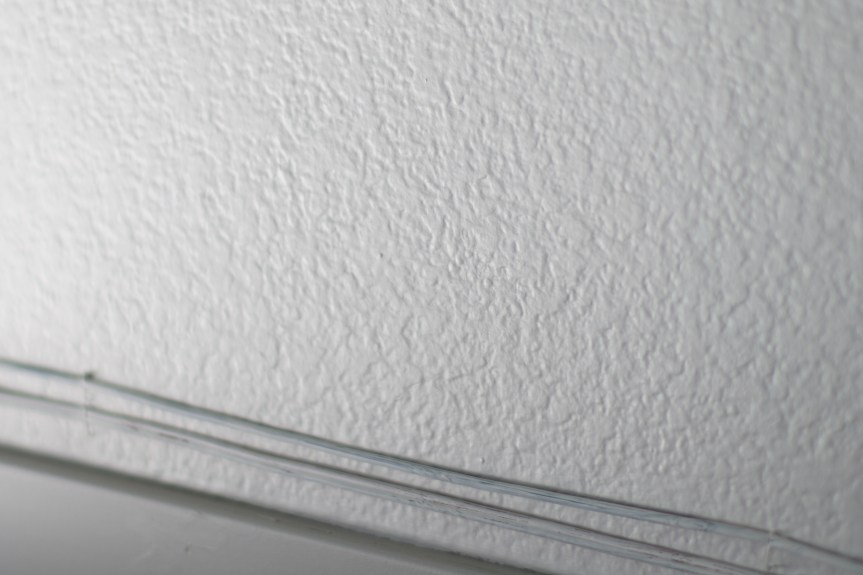
So along the lines of our daily mantra, “make do with what you’ve got”, I grabbed a stapler and left-over paint from the can sitting in the closet underneath the stairs. I took the wires and stapled them in horizontal tracks along the baseboards, trying to make their way as neatly as possible from the audio box to the projector. I then painted over them in white, LA apartment style. I took a step back, and admired my work.

DSC09104

DSC09106

DSC09103

It’s been about two weeks since I’ve done this project. To be frank, I have forgotten about the wires. It isn’t so much that they’re disguised completely. They’re only slightly less horrid than before. But there are more important things than worrying about how wiring looks against your baseboards. No one has commented on them, which means no one is really looking at them. Or if they are looking, maybe they approve of the city-style chic my painting over them has tried to mimic. Maybe it feels a bit more New York, emitting the older loft-like vibes of a more mature taste. We look on the bright side of things around here, always.


Curating Closets: When You Have None

It’s been a while, since I’ve written about curating closets, but closets have been at the forefront of [our] minds lately. Mostly, because we have none. I revealed in this post that our living space on the second floor has absolutely no closet space, not even in the bedroom.

Or pantry space.

Or a bathroom door.

Or a bedroom for that matter, technically. Loft living for the win.

So where to put storage? Our lifestyle is salvaged by a lone closet underneath the stairwell, located on the first floor (in the business space). We’ve placed a rod in this “coat closet” and have hung most of our clothes there, underneath the linens. There’s shelving above it, wherein sits our few sweaters that avoid hangers, to prolong their sweet little lives. The space is limited, and what minimalist closets we once thought we had have proved to be, well, not minimal enough. The husband owns too many tees, while I own too many formal a dress. So, a few words on curating, once again.

DSC08912.JPG

It’s dawned on me that the de-cluttering process is one of the most mindful practices I engage in. And I do it repetitively, because there’s still room for self-improvement, as well as self-reflection. Here’s what this new “space” has reminded me:

Have nothing in your house that you do not know to be useful, or believe to be beautiful.

I keep returning to this quote. I first discovered it perusing a shelf of cards at Daydream Surfshop in simple black lettering across a blank card. I loved it so much that I gave it as a birthday card to our roommate. When curating closets, I ask myself these two questions: “Does it have a purpose?” and “Do I love it?” Some may say “love” is a bit too extreme of an emotion, but I have found that liking something is not enough to stand the tests of time.

When you must choose between practicality and an item you love, sometimes it pays to choose the loved and less practical.

I was standing in a dressing room stall, holding two pairs of pants in my hands. I had been hiding away in there for thirty minutes or more, and the dressing room lady has checked in on me five times by now. Surely, she must wonder whether I’m in there solely because of the free AC. Not entirely untrue. But also, I was going through a tough dilemma, arguing with myself back and forth. Do I get the pair of practical denim which goes with everything in my closet and which can be worn on most days in casualness, or do I go with the auburn pant that wears beautifully, matches with a lot of my basic tops, but that I might hesitate doing some cooking in, lest it gets dirty? The truth of the matter is, I needed neither. In the end, I had walked out of the store with the pair of red pants in my hand. While practicality would have landed me a pair of denims that have everyday usability, I chose the thing that will make me ultimately the most happy. With something practical, one can wear it every day and never notice anything different. The practical one would not add anything to my life, except maybe a reason to de-clutter other denim pants that I already own. The red pair, on the other hand, will add joy to the every day. Plus, I’ve come to realize that when you love something, you end up using it as much as you possible can anyway. The moral is to choose actions that makes life happy, which is ultimately what we are living for. And when it comes to having items around,  living surrounded with items that you actually care about is the thing that matters most.

DSC08917.JPG

Know what you need for your particular lifestyle.

Speaking of having items around, know what works for you. I have been guilty before of buying things that other people have, with the illusion that I myself may need them too. However, as I grew to know myself, I have found that my lifestyle is quite different from other people’s lifestyle. There were so many things we owned previously that we found we didn’t use at all. A toaster that we had asked for on our wedding registry. Cosmetics that I thought every girl required. A beer tasting set, ’til I realized I no longer wish to consume beer. Specifically for wardrobes, I used to think I needed high heels to compensate for my height, and short dresses to make my legs appear longer. I used to think that tight clothing helped me, and that having my hair curled made me appear more adult. Today, I’d likely grab a tee, prefer overalls, and get itchy when my hair is anywhere near my face. Also, I enjoy the freedom that walking, running, jumping (?) in flat shoes afford me. My lifestyle has slowed down quite a bit, so blogging on couches does not require the same attire as going out to happy hours do. Coffee shops are more forgiving than clubs and house parties. Denim pants are more suited to bread baking than mini skirts. You get the gist.

Learn to recognize sentimentality and guilt. Learn to let the burden go.

The most difficult, and final advice. Too many times have I stared at an item which has not been touched, used, or even looked at for many months [ahem, years], yet still it remained in my possession. Always, the culprit holding me back from saying sayonara was sentimentality, followed by guilt. Handkerchiefs handed down to me from my mom when I was 8 years old, for example. The thought of letting something go makes me feel like I was stabbing someone I cared about in the back with a knife of betrayal. The wild imagery pulls me towards being a “good person” and keeping it for the sake of sentiment, and also, to avoid hurting anyone’s feelings. We must learn to recognize these moments, and then to ask, “what is it’s purpose?” If the only thing the item does is weigh us down with emotional burden, is that really worth keeping? Surely, your loved one did not mean to cause you such turmoil. I have found that creating space gives a higher ability to receive, while releasing negative physical, emotional and mental energy. Be kind to yourself, and know that the weight of the relationship should not come down to material things.

How about your closet space advice? I could use some inspiration. One day, I hope for that downstairs closet to have decent breathing room.